
VR Training Simulations Beat Classroom Training
VR training lets employees practice high-risk procedures, difficult conversations, and complex equipment safely and repeatedly. Here is where it beats the classroom, where it does not, and how to pilot it.
The Short Answer
VR training simulations for business have moved from conference demo to boardroom decision. In 2026, the question facing learning and development leaders is no longer whether virtual reality training works. The research says it does. The real question is where it beats classroom training, where it does not, and how to spend wisely on it.…
VR training simulations for business have moved from conference demo to boardroom decision. In 2026, the question facing learning and development leaders is no longer whether virtual reality training works. The research says it does. The real question is where it beats classroom training, where it does not, and how to spend wisely on it. This guide gives you an honest answer, backed by published studies and real enterprise deployments, so you can decide with confidence.
What VR Training Simulations for Business Are in 2026
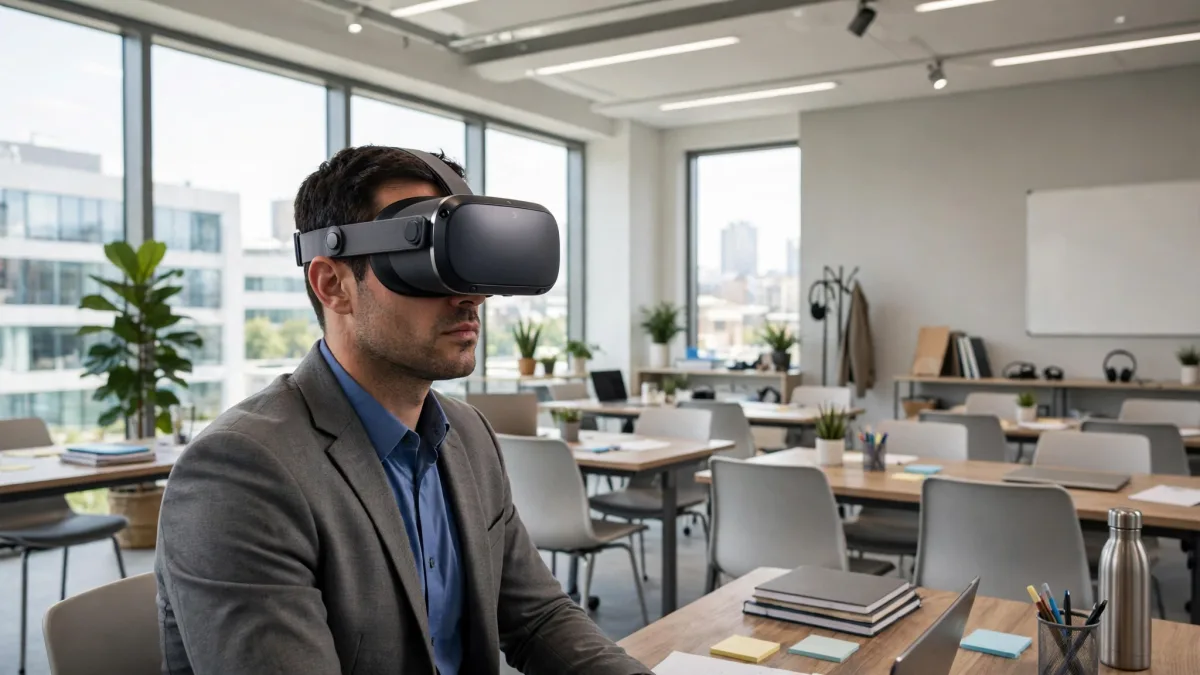
A VR training simulation puts an employee inside a realistic, interactive 3D workplace through a headset. Instead of watching a slide deck about a procedure, the learner performs it. They turn valves, inspect equipment, respond to a frustrated customer, or evacuate a building, all in a safe virtual space where mistakes cost nothing and every action can be measured.
The technology has matured fast. Standalone headsets no longer need a powerful PC or cables, setup takes minutes, and cloud platforms let a training team deploy the same module to offices in London, New York, and Lahore at the same time. According to Mordor Intelligence, the VR corporate training market was valued at USD 14.04 billion in 2025 and is forecast to reach USD 41.10 billion by 2031. Grand View Research puts the wider immersive training market at USD 16.4 billion in 2024, growing toward USD 69.6 billion by 2030.
Enterprise adoption backs that up. Figures reported by SHRM in 2024 show that 53 percent of global companies already use VR for employee training, and 77 percent plan to increase that investment. Walmart has deployed VR training across 4,700 US stores, and Bank of America has rolled it out to tens of thousands of associates on the way to its full 200,000-person workforce.
Where VR Training Simulations for Business Clearly Beat the Classroom
Classroom training is fine for sharing information. It is weak at building practiced skill. VR wins wherever the learning depends on doing, deciding under pressure, or repeating a procedure until it becomes habit. These are the five business cases where the advantage is clearest.
1. Hazardous and High-Risk Procedures
This is the strongest case of all. Fire response, chemical handling, working at height, electrical lockout, and emergency evacuation cannot be practiced for real without danger. In a classroom, learners watch a video and hope they remember it during a real incident. In VR, they practice the full procedure, make mistakes, see the consequences, and try again until the response is automatic.
The results are measurable. A peer-reviewed meta-analysis in Safety Science (2024) covering 52 studies found VR safety training outperformed conventional methods on both learning and long-term retention. A 2025 study in Scientific Reports of 200 industrial workers found VR training raised safety awareness by 30 percent and safety knowledge by 25 percent compared with conventional methods. Enterprise data compiled in 2026 links VR safety training to 20 to 43 percent fewer workplace injuries. For any business where one mistake can injure a person or shut down a plant, this alone justifies the investment.
2. Expensive Equipment Operation
Training a new operator on a live production line, an aircraft, or a piece of heavy machinery means taking expensive assets out of service and risking damage. VR removes that trade-off. Learners practice on a digital twin of the equipment, in the correct sequence, as many times as needed, before they ever touch the real thing.
Boeing reported a 75 percent reduction in assembly training time per person using VR, and Airbus cut maintenance process time by 25 percent with VR simulations. UPS reduced driver safety training from eight hours to two hours. The savings in downtime and instructor hours add up quickly.
3. Soft Skills and Difficult Conversations
It surprises many managers, but soft skills are one of the best-documented VR use cases. Handling an angry customer, giving difficult feedback, or leading an inclusive team are skills that improve only through practice, and classroom role play rarely feels real enough to change behavior.
PwC ran one of the largest corporate comparisons ever conducted, delivering the same leadership course as classroom, e-learning, and VR to more than 1,600 managers across 12 US locations. VR learners completed training up to four times faster than classroom learners, reported 275 percent more confidence in applying the skill afterward, felt 3.75 times more emotionally connected to the content, and were four times more focused than e-learning peers. After Bank of America's rollout, 97 percent of trainees said they felt confident applying what they had learned. For sales teams, customer service departments, and managers, that confidence gap is the whole point of training.
4. Onboarding at Scale
When a retailer, call center, or logistics company hires hundreds of people a month, classroom onboarding becomes a bottleneck. Every cohort waits for an instructor, a room, and a schedule. VR onboarding is identical every time, available on demand, and self-paced, which means new hires can start productive work sooner.
The consistency matters as much as the speed. Every learner gets the same scenarios, the same standards, and the same assessment. A new hire in Karachi gets exactly the same quality of training as a new hire in Manchester, and managers can see completion and performance data for every single person.
5. Geographically Distributed Teams
For companies with offices, sites, or field teams spread across cities and countries, classroom training means travel, hotels, and lost working days. VR brings the training room to the learner, so a distributed team can complete the same simulation in the same week without anyone boarding a plane.
The Measurable Benefits Behind the Hype
The business case for VR training rests on four measurable effects, and each one is supported by published evidence rather than vendor marketing.
- Speed: PwC found VR learners completed training up to four times faster than classroom learners, and still three times faster after including headset setup time.
- Retention: A 2024 meta-analysis in Safety Science reported a large effect on knowledge retention for VR-trained learners, and a University of Maryland study found 8.8 percent higher recall accuracy for VR learners. A 2025 CPR training trial published in Resuscitation Plus found that after twelve months, VR-trained learners had retained far more of their skills than the classroom group.
- Confidence: Learners who practice in VR are dramatically more confident applying skills on the job, with PwC reporting a 275 percent confidence advantage and Bank of America reporting 97 percent trainee confidence at scale.
- Safe failure: Learners can fail, see the consequences, and retry without risk to people, equipment, or customers. Repetition is unlimited, which is the single most reliable way to turn knowledge into skill.
PwC's cost model found VR training reaches cost parity with classroom training at around 375 learners, and runs about 52 percent cheaper at 3,000 learners, so the payback is fastest with large audiences, frequently repeated training, or high-cost mistakes.
Where VR Training Simulations for Business Do Not Beat the Classroom
An honest guide has to cover the limits. VR is a powerful tool, not a universal replacement, and there are situations where the classroom, a mentor, or simple e-learning is still the better choice.
Not every skill suits VR. Deep discussion, debate, creative brainstorming, and complex problem solving with colleagues benefit from real human interaction. A classroom workshop or a facilitated discussion can be the better format when the goal is shared thinking rather than practiced procedure.
Content development takes real effort. A generic off-the-shelf module is quick to deploy, but a custom simulation of your specific equipment, process, or customer scenario has to be designed, built, and tested. PwC found VR course production required up to 48 percent more initial investment than comparable classroom or e-learning content. That upfront cost is real, and it is exactly why piloting matters.
Hardware is a real cost of entry. Every learner needs a headset, headsets need charging, storage, cleaning, and occasional replacement, and someone has to manage the fleet. For a small team trained once a year, that overhead may not be worth it.
Some people experience motion sickness. A minority of users feel discomfort in VR, particularly in simulations with a lot of virtual movement. Good design keeps sessions short, avoids unnecessary motion, and always offers an alternative format for affected learners. Accessibility should be planned in from the start, not discovered after rollout.
How to Pilot VR Training Without Betting the Budget
The smartest way to adopt VR training is a small, measured pilot, not a company-wide rollout. Here is a practical five-step approach.
- Pick one high-value use case. Choose a single training need where classroom delivery is slow, inconsistent, risky, or expensive. Safety procedures, equipment onboarding, and customer-handling scenarios are the usual winners. One focused use case makes the pilot easy to measure.
- Set a classroom baseline first. Before the pilot, record how long the current training takes, what it costs per learner, and how learners perform afterward. Without a baseline, you cannot prove improvement.
- Run the pilot with a real cohort. Train 30 to 100 people, ideally across more than one location. Keep the rest on the existing method so you have a genuine comparison group.
- Measure what matters. Track completion time, assessment scores, confidence surveys, and on-the-job performance over the following weeks. Retention measured after 30 to 90 days is far more convincing than a same-day quiz.
- Scale in phases. If the pilot beats the baseline, expand to the next use case and the next team. Reuse the headset fleet and the platform, so each new module costs less than the first.
What to Look for in a VR Training Partner
Most businesses will buy VR training from a specialist partner rather than build it in-house, so choosing well matters. Look for a partner who can show real results, not just demos. Ask for case studies with measured outcomes, such as training time saved or assessment scores improved. Check that they build custom scenarios around your equipment and processes, not only resell generic modules. Confirm the content works on standalone headsets and integrates with your existing learning management system, so results flow into your normal reporting. Ask how they handle updates, because procedures change and your simulations must change with them. Finally, look for a partner who understands learning design, not just 3D graphics: the difference between a beautiful simulation and an effective one is instructional design. Working with a team experienced in game development, AR, and VR gives you both the technical craft and the learning structure in one place.
Immersive technology is also changing how customers experience products. Retailers already use augmented reality to let shoppers try before they buy, as covered in our guide to augmented reality retail, while wearable displays open a similar frontier for hands-free field work, explored in our Google Gemini smart glasses business guide for 2026. For teams combining VR with video learning, our article on corporate training videos that onboard forever shows how the two formats complement each other.
Frequently Asked Questions
Is VR training actually more effective than classroom training?
For practiced skills, yes, and the evidence is strong. A 2024 meta-analysis of 52 studies in Safety Science found VR outperformed traditional training on both learning and retention, and PwC's study of more than 1,600 managers found VR learners trained up to four times faster with far higher confidence.
How many employees need training before VR becomes cost-effective?
PwC's cost model found VR reaches cost parity with classroom training at around 375 learners, and delivers about 52 percent savings at 3,000 learners. The payback is fastest with large audiences, frequently repeated training, or high-cost real-world mistakes.
Which industries benefit most from VR training?
Manufacturing, healthcare, aviation, logistics, energy, retail, and financial services show the strongest results. Safety and compliance training is the largest use case, while soft skills and leadership training is the fastest growing.
Do employees actually like VR training?
Engagement is consistently high. In a Cox Communications pilot, 100 percent of learners said they would use VR training again, and Bank of America reported 97 percent of trainees felt confident applying what they had learned.
What about motion sickness and accessibility?
A minority of users experience discomfort, mainly in simulations with heavy virtual movement. Well-designed training keeps sessions short, minimizes artificial motion, and always offers an alternative format.
Can a small business use VR training, or is it only for large enterprises?
Small businesses can use it, especially with off-the-shelf modules for common needs like safety or customer service. Custom simulations make the most financial sense at scale, so smaller firms should start with a single high-value use case and expand from proven results.
VR training simulations will not replace every classroom, and they should not try to. What they do, better than any other method available today, is let people practice the things that matter most, safely, repeatedly, and at scale. The smart move is a focused pilot, measured honestly against your current training, and scaled only where the numbers prove it works. If you are ready to explore what VR training could do for your team, contact Skills Technology Solutions to discuss a pilot built around your highest-value use case.
Related Articles
Keep reading — more guides you may find useful.
Related Services
Services connected to this guide.