
Product Demo Videos That Sell: Best Practices
Most buyers will watch a good video before they read your product page. Here is what makes a product demo video convert, from the first ten seconds to the call to action.
The Short Answer
Most buyers will never read your product page word for word, but they will watch a good video. That is why product demo videos have become one of the highest converting assets a business can publish in 2026. A strong demo shows the product working, proves the promised outcome in real time, and answers the…
Most buyers will never read your product page word for word, but they will watch a good video. That is why product demo videos have become one of the highest converting assets a business can publish in 2026. A strong demo shows the product working, proves the promised outcome in real time, and answers the buyer’s biggest question, “Will this actually work for me?” before a sales call ever happens.
The evidence is clear. Wyzowl’s State of Video Marketing 2026 report finds 85% of consumers say a video has persuaded them to buy, and 96% have watched a video to understand a product better. Among B2B buyers, 73% prefer video as their way to learn about a product. This guide breaks down what makes a demo video convert, from the opening seconds to the call to action.
Why Product Demo Videos Convert So Well in 2026
Buying has changed. Gartner’s 2025 sales research found 61% of B2B buyers prefer a buying experience without a sales representative, and buyers spend only 17% of their purchase journey interacting with suppliers. Most of the decision happens before anyone talks to your team, and product demo videos fill that gap by letting buyers evaluate the product on their own terms, at any hour.
A demo also compresses the sales cycle. A prospect can watch a focused two minute demo, share it with colleagues, and arrive at the call already convinced. That sharing matters: TrustRadius’s 2025 survey of 2,058 tech buyers found purchases involve 4.8 people on average, and most never join the sales call. A recorded demo reaches all of them.
The data backs this up. Wyzowl’s 2026 figures show shoppers who watch a demo video are 1.81 times more likely to purchase, and 69% call the demo the most helpful content type when deciding. Landing pages with video convert at 4.8%, compared with 2.9% without. And 57% of video marketers say demos have reduced support queries, because buyers arrive already knowing how the product works.
| Metric | Figure | Source |
|---|---|---|
| Consumers persuaded to buy by video | 85% | Wyzowl, State of Video Marketing 2026 |
| People who watched a video to understand a product | 96% | Wyzowl, State of Video Marketing 2026 |
| Businesses using video as a marketing tool | 91% | Wyzowl, State of Video Marketing 2026 |
| Landing page conversion with video vs without | 4.8% vs 2.9% | Aberdeen Group research |
| Shoppers more likely to buy after watching a demo | 1.81 times | Wyzowl 2026 |
| Average people in a B2B buying group | 4.8 | TrustRadius 2025 survey, 2,058 buyers |
The Anatomy of Product Demo Videos That Sell
High converting product demo videos are short, specific, and built around the buyer’s problem rather than the seller’s feature list. Here is the structure that works most reliably:
- The outcome first (0 to 10 seconds): show the result the buyer wants, before you show how it is done.
- The problem (10 to 30 seconds): name the pain in the buyer’s own language.
- The demonstration (30 seconds to 2 minutes): show the real product solving that problem, step by step.
- Proof (throughout): real screens, real footage, real results, not promises.
- The call to action (final 10 seconds): one clear next step, stated plainly and shown on screen.
Show the Outcome First: The First 10 Seconds Rule
Viewers decide almost immediately whether to keep watching. A 2026 benchmark found videos under one minute are watched about 50% of the way through on average, while videos of 5 to 30 minutes reach only 28%. Even a short video is only watched halfway on average, so the opening seconds have to carry the point.
That is why the strongest demos open with the finished result: show the report generated, the order shipped, or the dashboard live, then work backwards. When a viewer sees the outcome in the first few seconds, they have a reason to stay for the how. When a video opens with a logo animation or a slow feature tour, the viewer leaves before the value appears. Test your opening with the sound off: does a stranger know what this product does for them? If not, rewrite it.
Keep It Short: The Ideal Length for a Demo Video
Shorter demos are watched further through. 2026 demo length data shows videos under one minute are watched 50% of the way through, videos of 1 to 3 minutes reach 46%, and videos of 5 to 30 minutes fall to 28%. For website marketing demos, the sweet spot is 60 to 120 seconds. For sales demos sent to a warm prospect, two to three minutes is fine, because that viewer already cares.
Length is a budget to spend wisely. A complex product may need three minutes to show a real workflow, while a simple one may need only 45 seconds. If a section does not show the product solving a real problem, cut it. Note that 2026 platform data from more than 6 million interactions shows the average sales demo runs 15 minutes 14 seconds, but average view time is only 5 minutes 14 seconds, so put your strongest proof early.
Real Footage Beats Stock Footage Every Time
Buyers can spot stock footage instantly, and it damages trust. A demo exists to prove the product works, and generic footage proves nothing. Film the actual product, interface, and result. For physical products, show the item in a real person’s hands, used the way a customer would use it. For software, record the real screen with real data, not a polished mockup.
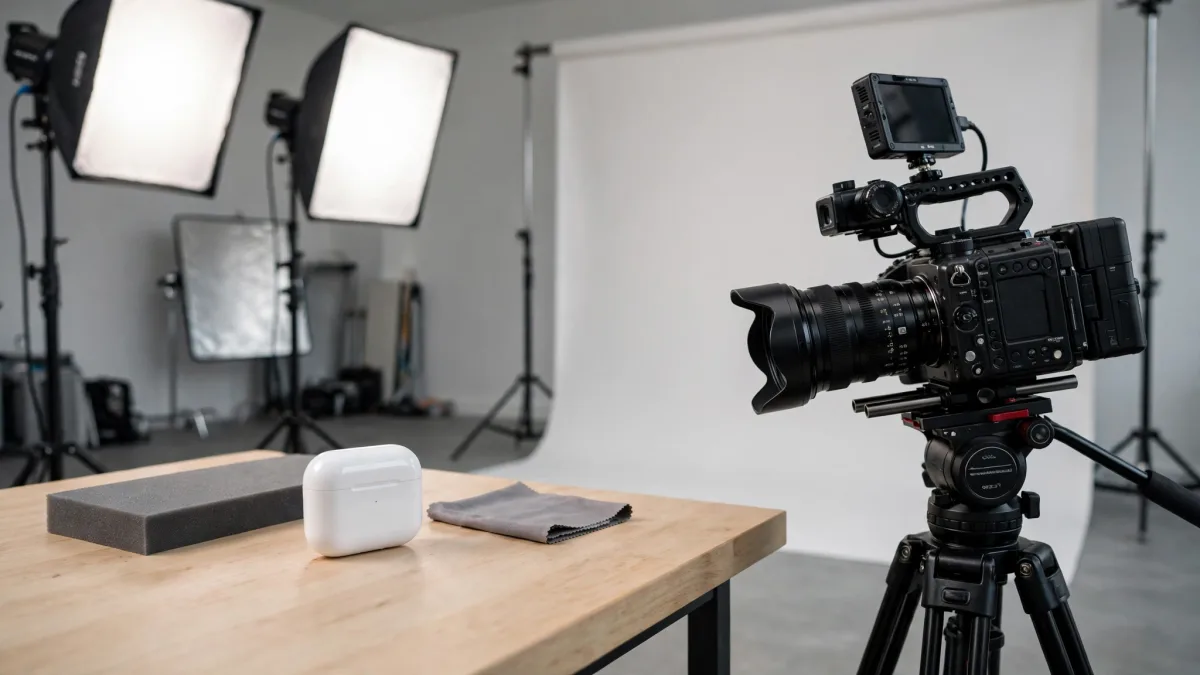
A clean, well lit recording of the real product outperforms a glossy video that never shows the product at all. Good lighting, clear audio, and steady framing separate a convincing demo from a shaky phone clip, so if your team lacks that capability in house, a professional crew is the sensible move. Our video production services cover scripting, filming, editing, and delivery, so the demo looks polished while staying honest about what the product does. For more on video in modern marketing, see our guide to AI video production for businesses in 2026.
A Simple Script Structure That Works
Great demo videos are written before they are filmed. A script keeps the video tight and makes sure the call to action is not an afterthought. Use this five part structure as a template.
1. Hook with the outcome
Open with the result in one sentence, such as how a week of manual invoicing becomes a five minute task. The viewer instantly knows whether to keep watching.
2. Name the problem
Describe the pain in the buyer’s words, not yours. This builds trust, because it proves you understand their world before you pitch a solution.
3. Demonstrate, do not describe
Show the product doing the work and narrate why it matters, but let the footage carry the proof. Aim for one clear workflow per video: a buyer who sees one problem solved completely converts more often than one who sees ten features skimmed.
4. Handle the objection
Address the doubt your buyer is already thinking. Show the setup or how quickly a new user gets started. One honest moment of proof removes the biggest reason to delay.
5. Close with one next step
End with a single, specific action: book a demo, start a trial, or request a quote. Say it out loud and show it on screen.
Calls to Action That Turn Viewers Into Buyers
A demo video without a clear call to action is just entertainment. The best calls to action are specific, low friction, and matched to where the viewer is in the journey: a trial or purchase on a product page, a reply or booked call in a sales email, and a visit to the product page from social media.
- One CTA per video. Two competing actions split attention and reduce clicks.
- Say it twice. Mention the next step midway, then repeat it at the end with the link on screen.
- Make it visible. Use an end screen or a clickable button, not just a mention in the voiceover.
- Match the commitment. A cold viewer is more likely to watch another video than to book a sales call, while a warm prospect who watched the full demo is ready for the call.
Where to Distribute Your Demo Video
A demo only converts if buyers see it, so placement matters as much as production. Start with the product page, where intent is highest: a demo near the top reaches buyers at the exact moment they are deciding. Our breakdown of product page optimization explains how video, trust signals, and layout turn that intent into sales.
- Website and landing pages: embed the demo on the product page and campaign landing pages. Pages with video convert at 4.8% versus 2.9% without.
- Email: include the demo in welcome sequences and sales follow ups. A short clip linked to the full video lifts click rates and shortens the reply cycle.
- Sales calls and proposals: send the demo before the call so the meeting starts with questions, not a walkthrough. Forwarded demos get watched closely: stakeholders reached by internal sharing engaged at 61%, compared with 28% for the original recipient, according to 2026 platform data.
- Social media: cut a 15 to 30 second version for LinkedIn, YouTube Shorts, Instagram, and TikTok. Short form tools can produce these cuts quickly, as explained in our look at 15 second AI video for business, with each clip linking back to the full demo.
- Support and onboarding: the same demo, lightly re edited, can welcome new customers and reduce support load. Wyzowl reports that 57% of video marketers say demo videos have decreased support queries.
Common Mistakes That Kill Demo Video Conversions
Most demo videos fail for fixable reasons. Watch for these seven mistakes:
- Starting with your company, not the buyer. Logos and history belong at the end, if anywhere.
- Listing features instead of showing outcomes. Buyers buy the result, not the feature list.
- Running too long. A 15 minute tour loses most viewers by minute five.
- Using stock footage. Generic clips destroy credibility in a video whose job is proof.
- Hiding the product. If the viewer cannot see the real product working, the demo has failed.
- Forgetting the call to action. Ending with a logo instead of a next step wastes everything before it.
- Publishing once and forgetting it. Review each demo every quarter and update anything that no longer matches the current product.
How to Measure Whether Your Demo Video Works
Views alone tell you almost nothing. Judge a demo by whether it moves buyers forward: play rate (a low rate means weak placement or a poor thumbnail), watch through rate (an early drop points to a weak opening), click through rate on the CTA (the number that matters most), conversion rate (compare pages with and without the demo), and sales impact (reply rates and meetings booked). Review these monthly and test one change at a time. Small improvements compound faster than a full reshoot every year.
Frequently Asked Questions
How long should a product demo video be?
For a website or landing page, aim for 60 to 120 seconds. 2026 benchmarks show videos under one minute are watched about 50% of the way through, while videos of 5 to 30 minutes reach only 28%. Sales demos for warm prospects can run two to three minutes.
What should a product demo video show first?
Show the outcome first. Open with the finished result the buyer wants, then show how the product achieves it. Viewers decide in the first few seconds whether to keep watching, so the opening must prove value immediately rather than starting with a logo or company history.
Do product demo videos really increase sales?
Yes. Wyzowl’s 2026 research shows demo viewers are 1.81 times more likely to purchase, 69% of shoppers call the demo the most helpful content type, and 85% of consumers say a video has persuaded them to buy. Landing pages with video convert at 4.8% versus 2.9% without.
Should I use real product footage or stock footage in a demo?
Always use real product footage. A demo exists to prove the product works, and stock footage proves nothing. Film the actual product in use, or record the real software interface with real data. Buyers trust what they can see working.
Where should I put my product demo video?
Start with the product page, where buying intent is highest, then reuse it in email, sales follow ups, proposals, and social clips. Demos get forwarded inside buying groups, and stakeholders reached by internal sharing engage at 61%, versus 28% for the original recipient.
How often should I update a product demo video?
Review each demo every quarter and update it whenever the product changes in a way a buyer would notice, such as a redesigned interface or a new workflow. An outdated demo is worse than no demo, because it teaches buyers the wrong thing.
Ready to turn your product into a video that sells? A focused, professionally produced demo can shorten your sales cycle, reach every stakeholder in the buying group, and keep converting long after it is published. Contact Skills Technology Solutions to plan your next product demo video.
Related Articles
Keep reading — more guides you may find useful.

Related Services
Services connected to this guide.