
Blockchain Verifiable Documents Explained for Business
Blockchain verifiable documents let anyone confirm a certificate, report or warranty is genuine in seconds, without calling the issuer. This guide explains the hash and timestamp mechanism, what stays off chain, and a complete employer verification flow.
The Short Answer
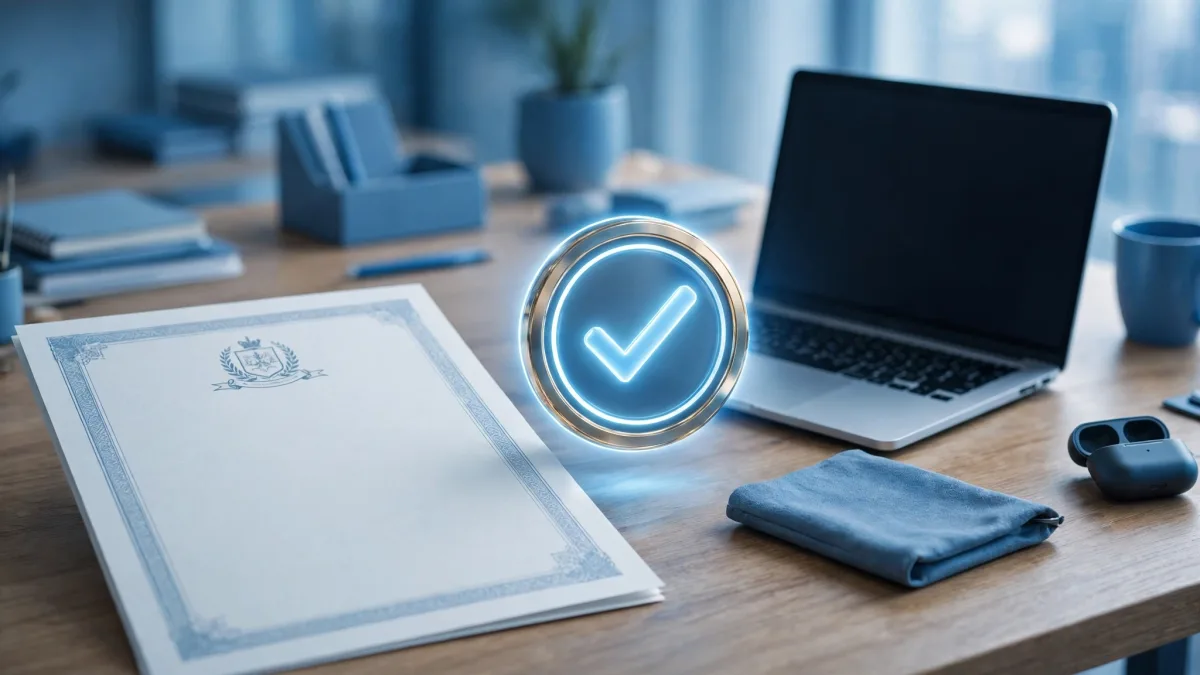
Blockchain verifiable documents are changing how businesses prove that a piece of paper, or a PDF, is genuine. Instead of phoning an issuer, waiting days for a confirmation email, or trusting a scanned copy at face value, a verifier can check a document in seconds. The strongest blockchain use case here is not coins or…
Blockchain verifiable documents are changing how businesses prove that a piece of paper, or a PDF, is genuine. Instead of phoning an issuer, waiting days for a confirmation email, or trusting a scanned copy at face value, a verifier can check a document in seconds. The strongest blockchain use case here is not coins or speculation. It is a simple, practical idea: prove a document is real without calling the issuer.
Business runs on documents other people must trust: a degree certificate in a hiring file, a safety credential for a site worker, an inspection report attached to a property sale, a warranty card for expensive equipment, and an audit record shown to a regulator. In every case, the document only has value if the reader believes it, and today that belief usually depends on slow manual checks that forgers know how to exploit.
This guide explains how blockchain verification works in plain language, what belongs on chain and what must stay off chain, and walks through one complete verification flow step by step.
How Blockchain Verifiable Documents Work
The core idea is smaller than most people expect. A blockchain does not need to store your document. It should not. It stores a proof about the document, and that proof is enough to detect any tampering.
The mechanism has three parts. First, the document is run through a cryptographic hash function, commonly SHA-256. A hash is a fixed length string of characters that acts as a digital fingerprint of the file. Change even one character or pixel, and the fingerprint changes completely, yet it reveals nothing about the contents, so it can be shared safely.
Second, that fingerprint is recorded on a blockchain together with a timestamp and the issuer's digital signature. Because a blockchain is replicated across many independent computers and its history cannot be rewritten without detection, the record becomes a durable, tamper evident anchor.
Third, verification reverses the process. A verifier recomputes the fingerprint of the document they hold and compares it with the fingerprint stored on chain. If the two match, the document is exactly the one the issuer recorded. If they differ, something has changed and the document fails the check, with no phone call or access to the issuer's systems needed.
The signature answers a second question: not just "is this file unchanged?" but "did this issuer really sign it?" Together, the hash, the signature, and the timestamp answer the three questions every verifier cares about: is it intact, is it authentic, and when was it issued?
What Goes On Chain and What Stays Off Chain
This distinction is the most important design decision in any verification system. The rule is simple: put the proof on chain, keep the document and the personal data off chain.
| Stays off chain | Goes on chain |
|---|---|
| The document itself (PDF, image, or file) | The document fingerprint (hash) |
| Personal data such as grades, addresses, or ID numbers | The issuer signature or credential reference |
| Confidential case, medical, or commercial details | The timestamp and block reference |
| The holder's private keys and wallet data | A revocation status reference, where applicable |
This is how real deployments work. When the Dubai International Financial Centre Courts began issuing blockchain verifiable court documents in October 2026, court orders and hearing records carried a nontransferable digital authenticity credential recorded on the Avalanche C-Chain, while the document itself and all confidential case information stayed off chain. Banks, courts, and authorities anywhere in the world can now confirm origin and integrity within seconds, without seeing the contents.
The same principle protects individuals: a degree certificate can be verified without publishing grades, and an inspection report can be checked without exposing property details.
A Concrete Verification Flow: An Employer Checking a Certificate
Here is exactly how blockchain verifiable documents work when an employer checks a candidate's training certificate, from issue to verified result.
- The training provider issues the certificate. A candidate completes a safety training course. The provider creates the certificate as a PDF, computes its fingerprint, and signs it with its own cryptographic key.
- The proof is anchored on chain. The signed fingerprint, the issue date, and a credential reference are recorded on the blockchain. The certificate file itself is not uploaded. The candidate receives the PDF plus a verification link or QR code.
- The candidate shares the certificate. When applying for a job, the candidate sends the PDF and the verification link to the employer, just as with any normal certificate.
- The employer opens the verification page. The employer clicks the link or scans the QR code to open a verification page run by the provider, a verification service, or a public tool that reads the blockchain directly.
- The employer uploads the certificate file. The employer uploads the PDF they received. The tool computes the fingerprint of that exact file on the spot, and the file does not need to be stored by the verifier.
- The tool compares fingerprints. The tool looks up the fingerprint recorded on chain, compares it with the freshly computed fingerprint, and checks the issuer signature.
- The tool checks revocation status. A good system also checks whether the credential has since been revoked, for example if it expired, was issued in error, or was withdrawn. A valid signature alone does not mean a credential is still current.
- The employer sees a clear result. Within seconds, the employer sees one of two outcomes: verified, with the issuer name and issue date; or failed, with a reason such as "file has been altered" or "credential revoked." That result can be recorded in the hiring file as evidence of the check.
Notice what did not happen: no email to the training provider, no staff needed on hand to answer, and no candidate personal data published on a public ledger. A visually perfect forgery would still fail at step six because its fingerprint would not match.
The same flow works for a client checking an inspection report: upload the report, compare its fingerprint with the inspector's anchored record, and know within seconds whether it is the genuine, unaltered original.
Where Blockchain Verifiable Documents Deliver the Most Value
Verification pays off fastest wherever documents travel between organisations, where forgery is tempting, and where manual checks are slow.
Degree certificates and academic credentials
Universities and school boards are already moving in this direction. The Himachal Pradesh Board of School Education in India announced blockchain backed, QR coded certificates for Class X and XII students from the 2025-26 academic session, so colleges, employers, and foreign institutions can verify authenticity within seconds instead of waiting through lengthy manual processes. Cross border checks are traditionally the slowest of all, so this speed matters enormously to international employers.
Training and professional credentials
Safety certificates, trade licences, and professional records expire, get renewed, and sometimes get revoked. A verifiable credential carries its expiry and revocation status with it, so a site manager can confirm on the day that a worker's certification is still valid, not just that it once existed.
Inspection reports and compliance records
Property buyers, insurers, and regulators rely on inspection reports written by third parties. If a report can be altered after issue, for example to hide a defect, everyone downstream is exposed. Anchoring the report's fingerprint at issue closes that gap: any later edit produces a different fingerprint and fails verification.
Warranties and product records
A verifiable warranty record, linked to a serial number and issue date, lets a service centre confirm coverage instantly while keeping customer details off chain. The same pattern works for service histories and calibration records.
Audit records and legal documents
Auditors and courts need to know that a record existed in a particular form at a particular time. A blockchain timestamp provides exactly that, verifiable without trusting the record keeper. The DIFC Courts example shows this pattern reaching the legal system, where cross border trust is hardest to establish.
What Verification Does Not Prove
Blockchain verification has clear limits that any buyer should understand before investing.
First, verification proves that a document is unchanged and that a particular issuer signed it. It does not prove that the issuer is trustworthy. A convincing certificate from a fake institution will verify perfectly if that institution is the issuer, so verifiers must still check that they trust the issuer, just as they would check that a university is real before trusting its paper degree.
Second, verification of authenticity is not the same as legal recognition. Confirming that a court document is genuine does not automatically establish its legal validity or guarantee recognition in another jurisdiction, so cross border businesses should confirm legal standing separately from technical verification.
Third, revocation handling must be designed, not assumed. The W3C Verifiable Credentials Data Model version 2.0 became a global web standard in May 2025, and W3C work on credential barcodes and revocation continues, because a digital signature alone cannot stop a stolen or copied credential from passing a check. Any system you buy must explain, in plain terms, how a revoked credential fails verification and how quickly that takes effect.
Fourth, standards and interoperability decide whether your credentials will still be useful in five years. Credentials built on open standards, such as W3C Verifiable Credentials and OpenID for Verifiable Credentials protocols, can be checked by many tools and wallets, while a closed format locks you to one vendor and may strand your credentials if that vendor disappears.
Getting Started With Blockchain Verifiable Documents
You do not need to rebuild your whole document workflow to start. Most organisations begin with one high volume, high friction document type, prove the flow, and then expand:
- Pick one document type. Choose the document that causes the most verification requests, delays, or fraud concerns.
- Decide public or permissioned. A public chain maximises independent verifiability by anyone, anywhere. A permissioned chain restricts who can read or write records, which some regulated industries prefer.
- Insist on open standards. Ask vendors whether credentials follow W3C Verifiable Credentials and whether verifiers outside their platform can check them.
- Design revocation on day one. Define who can revoke a credential, in what circumstances, and how fast revocation reaches verifiers.
- Keep personal data off chain. Confirm in writing that documents and personal data are never stored on the ledger.
- Make verification effortless. A QR code or link on every issued document, leading to a plain language result, is what turns a technical system into one people actually use.
- Plan for the long term. Credentials may need to verify for decades, so choose durable standards and keep issuer keys managed securely.
For a wider view, see our guide to blockchain for business in 2026 and our practical guide to smart contracts. Because verification systems handle sensitive records, also read about data privacy and ownership before you design your data flows.
If you want to build a verification system for your own certificates, reports, or records, explore our blockchain and Web3 development services to see how we approach these projects.
Frequently Asked Questions
What is a blockchain verifiable document?
A blockchain verifiable document is a normal document, such as a certificate or report, whose fingerprint and issuer signature have been recorded on a blockchain. Anyone can recompute the fingerprint and compare it with the on chain record to confirm the document is genuine and unchanged, without contacting the issuer.
Is the document itself stored on the blockchain?
No. Only a fingerprint (hash), a signature, and a timestamp reference are stored on chain. The document itself and any personal data stay off chain, protecting privacy and keeping confidential information out of the ledger.
Can a forged document pass blockchain verification?
A forged document will fail verification if it differs in any way from the original, because even a tiny change produces a completely different fingerprint. The main risk is a credential issued by an untrustworthy or fake issuer, so verifiers should always confirm they trust the issuer as well as the document.
What happens if a certificate is revoked after it is issued?
A well designed system checks a revocation list or status record during every verification, so a revoked certificate returns a failed result even though its original signature was valid. Ask any vendor how revocation works before you buy, because this is where weak systems fail.
Do verifiers need special software or a crypto wallet?
Usually not. Most verification flows work through a normal web page: the verifier uploads the document or scans a QR code and sees a plain language result. Wallets are mainly relevant for holders who store credentials, not for everyday verifiers.
How long does a blockchain verification remain valid?
The on chain record is durable for as long as the blockchain exists, so a document can in principle be verified decades later. In practice, long term validity also depends on the issuer's keys staying trustworthy, revocation records staying available, and the credential using standards future tools can still read.
Ready to make your documents verifiable? If your business issues certificates, reports, warranties, or records that other people need to trust, blockchain verification can remove the delays and doubt from that process. Contact us to discuss a system built for your documents and verifiers.
Related Articles
Keep reading — more guides you may find useful.
Related Services
Services connected to this guide.