
Blockchain for Business 2026: Real Use Cases
A practical 2026 guide to blockchain for business: real use cases in supply chains, smart contracts, tokenization and notarization, plus an honest fit test for when a database is enough.
The Short Answer
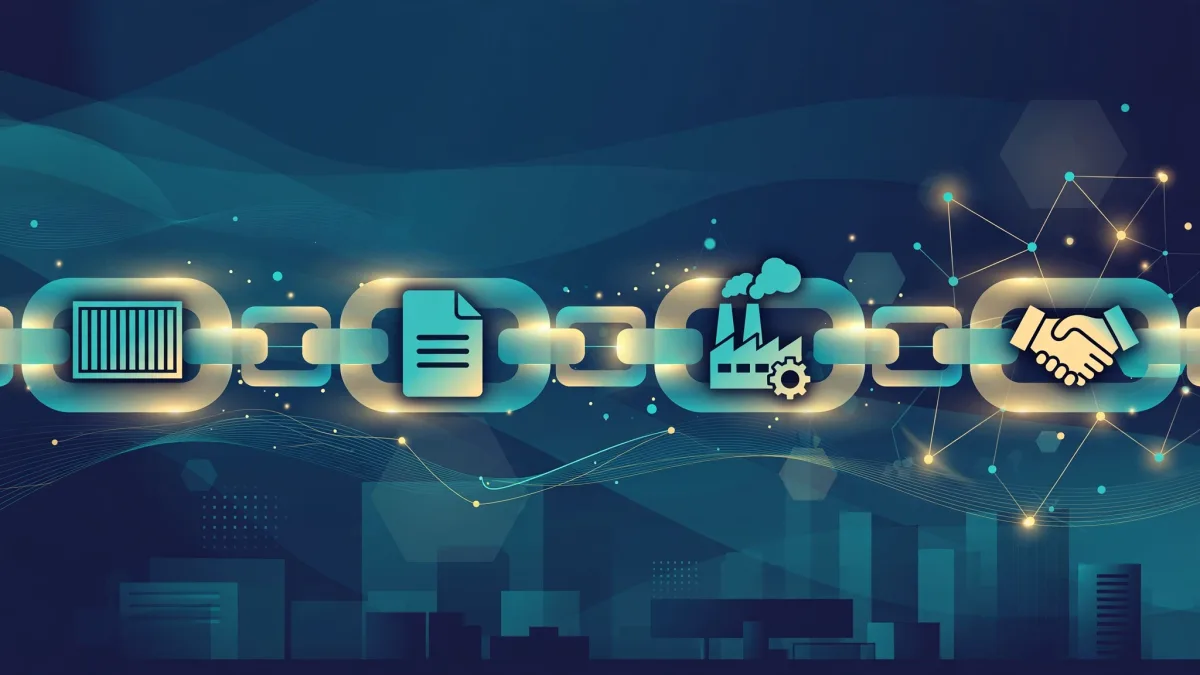
When most executives hear the word blockchain, they still think of volatile cryptocurrency trading. That perception is years out of date. Blockchain for business in 2026 means something far more practical: shared digital ledgers that help companies track products across borders, automate B2B agreements, and prove the authenticity of documents without relying on a single…
When most executives hear the word blockchain, they still think of volatile cryptocurrency trading. That perception is years out of date. Blockchain for business in 2026 means something far more practical: shared digital ledgers that help companies track products across borders, automate B2B agreements, and prove the authenticity of documents without relying on a single trusted intermediary. Enterprise spending on blockchain implementations has now surpassed $31 billion globally, driven by automation and payment efficiency initiatives, and nearly 70% of organizations deploying blockchain solutions prioritize smart contracts for workflow automation.
The technology has moved past its pilot-project phase. What follows is an honest look at where blockchain genuinely creates business value in 2026, which use cases are already working in production, and the equally important question of when a conventional database is the better answer.
Why Blockchain for Business Looks Different in 2026
The defining shift of the last two years is that blockchain for business deployments stopped trying to decentralize everything. Instead, enterprises settled on permissioned and consortium models: private networks where known participants such as suppliers, banks, and regulators share one tamper-evident ledger. These designs balance transparency with regulatory control and performance, which is exactly what cautious compliance teams needed to say yes.
A second shift is regulatory clarity. Enterprise-friendly frameworks have made it possible to build on-chain financial products with confidence, and scalable platforms such as Hyperledger, Corda, and permissioned Ethereum have matured into production-grade infrastructure. The result is a quiet but steady wave of deployments focused on efficiency, compliance, and resilience rather than speculation.
Blockchain for Business Use Case 1: Supply Chain Traceability
Supply chain transparency remains the leading enterprise blockchain use case, and for good reason. Modern supply chains involve dozens of parties across many jurisdictions, and none of them fully trust the others' spreadsheets. A shared ledger gives every participant a single, synchronized record of what moved, when, and under what conditions.
The landmark example is Walmart and IBM Food Trust. Built on Hyperledger Fabric, the network lets Walmart trace a food product from store shelf back to the farm in about 2.2 seconds, down from roughly seven days using paper-based methods. When a contamination scare hits, that speed is the difference between recalling one batch and pulling entire product lines from shelves. The same network connects major producers such as Nestle, which industry analyses projected could save tens of millions through reduced recall and reconciliation costs.
Food is only the beginning. The Nueva Pescanova Group uses blockchain to trace seafood provenance, verifying sustainability claims that consumers increasingly demand. In pharmaceuticals, distributors record chain-of-custody events on-chain to expose counterfeit medicines, a problem that is particularly serious in emerging markets. And platforms such as VeChain underpin luxury-goods authentication, letting buyers verify that a handbag or watch is genuine before they pay.
The TradeLens lesson
Honest coverage requires one cautionary tale. Maersk's TradeLens tracked 67 million containers and cut documentation costs by roughly 20%, yet it was shut down in 2023. Academic research classifies this as a governance failure rather than a technology failure: competing carriers refused to share data on a platform co-owned by their largest rival. The lesson for 2026 is clear. Before choosing blockchain, solve the consortium politics first. A carefully chosen technology partner will press you on governance before writing a single line of code.
Blockchain for Business Use Case 2: Document Notarization and Digital Credentials
Businesses lose enormous amounts of time proving that documents are real. Export certificates, academic degrees, inspection reports, and licenses all require manual verification, and forged paperwork costs industries billions. Blockchain turns a document into a tamper-proof digital fact: the document's cryptographic fingerprint is anchored on a ledger, and anyone can verify it in seconds without contacting the issuer.
This use case is expanding fast in 2026. Universities issue blockchain-anchored diplomas that employers verify instantly. Export authorities and customs agencies in several countries now accept blockchain-notarized trade documents. In healthcare, clinical trial data and professional credentials are being sealed on-chain to make audits straightforward and fraud nearly impossible.
For small and mid-sized firms, this is often the lowest-friction entry point into blockchain. A notarization service typically runs as a simple add-on to existing document workflows, and it plugs naturally into a broader digital transformation roadmap without requiring the whole supply chain to join a consortium.
Tokenized Assets: Finance Meets the Real Economy
Tokenization means representing real-world assets, from treasury products and corporate bonds to real estate and carbon credits, as digital tokens on a blockchain. It is the fastest-growing enterprise blockchain segment in 2026. Tokenized assets excluding stablecoins crossed $30 billion by mid-2026, up from about $12 billion a year earlier, and more than $7.4 billion in tokenized US Treasury products relied on smart contracts in 2025 alone.
The business logic is straightforward. Tokenized securities settle faster, need less manual reconciliation, and carry compliance rules in their code. Boston Consulting Group projects tokenized real-world assets could reach $16 trillion by 2030, while McKinsey research suggests an end-to-end tokenized bond lifecycle could unlock operational efficiency improvements of at least 40% through automation and embedded compliance.
Banks and institutions are already there. JPMorgan's Onyx platform uses blockchain for interbank transactions, and a growing share of asset managers are piloting smart-contract-powered money-market products. For businesses outside finance, tokenization opens new funding paths: invoices can be tokenized and financed on-chain, cutting the settlement cycles that strangle supplier cash flow. It is worth noting the constraint here too. A 2025 study in Springer's Digital Finance journal found blockchain-based trade finance reduced per-transaction costs from $1,209 to $82 and processing time from 8.4 days to 0.2 days, which shows the ceiling of what is possible when the whole workflow moves on-chain.
Smart Contracts That Automate B2B Agreements
Smart contracts are self-executing agreements coded on a blockchain: when agreed conditions are met, the contract acts automatically, with no paperwork and no disputes about what happened. Industry data tracked across 2025 deployments shows smart contracts lowering administrative costs by up to 42% in invoicing and settlement workflows.
Trade finance is the showcase. The letter of credit, a bank's promise to pay an exporter on presentation of shipping documents, has traditionally been a slow, paper-heavy, fraud-prone process. Replacing it with a smart contract on a shared ledger shared by importer, exporter, and banks automates verification and release of funds. Trade finance processing times drop by an average of 81%, and cross-border smart-contract settlements have gone from two or three days to under five minutes in test-bank deployments.
Insurance offers both promise and a lesson. AXA's Fizzy product was a parametric flight-delay policy powered by a smart contract: an oracle confirmed whether a flight was delayed beyond two hours, and payouts triggered automatically with no claim forms. The technology worked elegantly, yet AXA discontinued Fizzy, reportedly because the business model could not gain traction through sales partnerships. The takeaway is not that smart-contract insurance failed, but that the hardest part is distribution and partnerships, not the code. European insurers are now redeploying the same parametric pattern for crop and freight insurance, where institutional buyers already exist.
When a Shared Database Is Enough: The Honest Fit Test
Here is the insight too many vendors will not give you. Blockchain is a poor fit whenever a single trusted party can hold the data. If your company controls all the writers and all the readers, a conventional database is faster, simpler, and cheaper. As one industry report puts it, if a use case does not require shared state, immutability, or multi-party coordination, it is usually a poor fit for blockchain.
Use this three-question test before committing:
| Question | If yes | If no |
|---|---|---|
| Do multiple organizations write to and read from the same data, with no single party everyone trusts? | Blockchain is a strong candidate. | A shared database or API is enough. |
| Is tamper evidence valuable, for example for audits, compliance, or dispute resolution? | Blockchain's immutability adds real value. | Audit logs in a normal database suffice. |
| Can parts of the agreement be expressed as clear, objective rules? | Smart contracts can automate them. | Stick to human-readable contracts. |
Deciding well matters as much as building well. If you are still choosing between architectures, this guide to custom versus off-the-shelf software decisions applies the same kind of structured thinking. And because on-chain systems have their own attack surface, pair any deployment with a solid cybersecurity baseline for keys, access controls, and monitoring.
A Concrete Example of Our Own Analysis
Consider a mid-sized textile exporter shipping to European buyers who must now prove sustainable sourcing under new EU due-diligence rules. Each season the exporter pays an auditor to verify suppliers, prints certificates, and emails PDFs that buyers cannot easily verify. A consortium blockchain shared by the exporter, its mills, the auditor, and the buyer's compliance team would let every batch carry its own verifiable trail: cotton origin, dye certifications, labor audit timestamps, sealed immutably as the batch moves. The auditor's data feeds in once, and every buyer verifies independently. This is a hypothetical illustration, not a client case, but it shows exactly where blockchain wins: several parties, low mutual trust, and high verification value. The exporter does not need cryptocurrency, token trading, or public chains. It needs a boring, private, reliable ledger.
How to Evaluate Blockchain for Your Business in 2026
Start from a business problem, never from the technology. Map the parties involved in one workflow, count the reconciliation emails, and measure the dispute costs. If the fit test above comes back positive, run a contained pilot: one supplier group, one document type, or one product line, with success metrics agreed in advance. Avoid the classic mistake of building a platform before the first partner commits data. The TradeLens story is the warning label.
Skills Technology Solutions builds blockchain and Web3 solutions grounded in exactly this discipline: permissioned networks, smart-contract automation, and tokenization projects scoped to real business pain, starting with fit assessment and pilot design rather than grand platform promises.
Frequently Asked Questions
Is blockchain for business the same as cryptocurrency?
No. Cryptocurrency is one application of blockchain. Enterprise blockchain uses the underlying ledger technology for tracking, verification, and automation, typically on private networks that have nothing to do with public crypto markets.
What are the most proven blockchain use cases for businesses?
Supply chain traceability, trade finance automation, document notarization, tokenized assets, and smart-contract automation of B2B agreements are the most mature. Each has production deployments and measurable results behind it.
How much technical change does blockchain adoption require?
Less than most leaders fear. Permissioned blockchain platforms expose standard APIs, and notarization or verification features can integrate with existing ERP and document systems without replacing them.
Is blockchain secure for sensitive business data?
Private and consortium networks keep data visible only to authorized participants, and cryptography protects records against tampering. As with any system, security depends on proper key management and infrastructure hygiene.
When should a business avoid blockchain?
When a single organization controls all the data writers, when there is no multi-party trust problem, or when requirements are simple enough for a standard database. Blockchain adds value through shared, tamper-evident state, not as a general-purpose database upgrade.
Which industries benefit most from blockchain in 2026?
Food and pharmaceuticals lead in traceability, financial services in tokenization and settlement, logistics in trade documents, and construction, energy, and agriculture are adopting fast for sustainability and provenance proof.
Ready to find out whether blockchain fits your business? Talk to our team for a practical fit assessment, from pilot design to full production deployment.
Related Articles
Keep reading — more guides you may find useful.
Related Services
Services connected to this guide.