
AiMOGA Mobo: A Buyer Guide to Home Companion Robots
AiMOGA Mobo is a small home companion robot now on pre-order. This buyer guide helps businesses check privacy, safety, support, and pre-order terms before deploying one.
The Short Answer
The AiMOGA Mobo home robot has arrived at an interesting moment. Families are curious about robots that can talk, remember, and help around the house, while businesses are asking a harder question: what happens when a machine like this is placed in front of customers, residents, or children? AiMOGA Robotics, the robotics brand of Chery,…
The AiMOGA Mobo home robot has arrived at an interesting moment. Families are curious about robots that can talk, remember, and help around the house, while businesses are asking a harder question: what happens when a machine like this is placed in front of customers, residents, or children? AiMOGA Robotics, the robotics brand of Chery, unveiled Mobo in Wuhu, China, on October 21, 2026, and opened global pre-orders the same day. It is described as the company's first consumer-grade family companion humanoid robot.
This guide is a practical buyer guide for decision makers considering a companion robot for a customer-facing or care setting, such as a reception area, a care home lounge, or a showroom. It explains what Mobo is reported to do, where the real risks sit, and which questions to ask before you commit to a pre-order, especially when no delivery date has been given.
What the AiMOGA Mobo Home Robot Actually Does
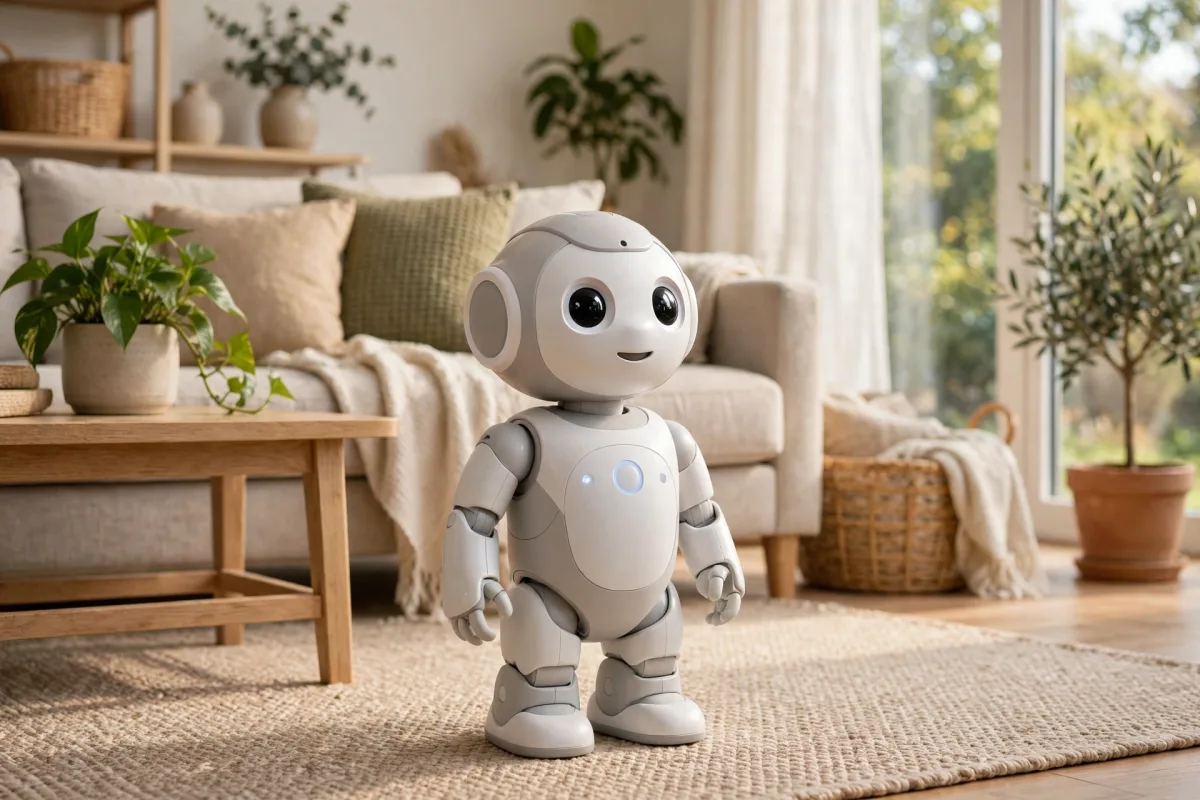
Mobo is a small humanoid robot, standing 0.9 meters tall, roughly the height of a young child. According to AiMOGA, it has 22 degrees of freedom, so its body can gesture, dance, and express itself, and it supports more than 20 languages. A robot that moves, gestures, and remembers feels more like a presence in the room than a robot that only answers questions.
Mobo runs AiMOGA's MoAgent embodied intelligence system. In plain terms, MoAgent connects what the robot sees and hears with what it decides to do next. AiMOGA describes layers for spatial perception, interaction, execution, decision-making, and cognition, forming a perception, decision, execution, and feedback loop. The system includes long-term memory, so Mobo can follow up on earlier conversations, remember habits and preferences, and remind users of planned activities. For children, AiMOGA highlights object recognition and question answering, storytelling, and interactive English learning. For older family members, it highlights conversation and user-defined reminders.
At launch, AiMOGA also pointed to workplace style demonstrations. In one, Mobo handled meeting notifications and inspection tasks, responded to an unexpected question, and then resumed its original work. AiMOGA reports up to 16 parallel tasks and interruption response times under 0.2 seconds. Treat those figures as vendor-reported demonstration results, not guarantees for a busy home or a noisy reception area.
The AiMOGA Mobo Home Robot in Business and Care Settings
A family companion robot and a business companion robot are not quite the same job, even when the hardware is identical. At home, a mistake is often funny or mildly annoying. In a care setting or a customer-facing space, a mistake can confuse a vulnerable person, misdirect a visitor, or create a record that later needs explaining. Judge Mobo not only by what it can do in a demonstration, but by how it behaves when instructions are unclear, when a person changes their mind mid-sentence, or when the room gets busy.
There are settings where a small, friendly companion robot could genuinely help. In a care home lounge, it could offer conversation, reminders, and simple interactive activities during quiet hours. In a clinic or hotel reception, it could greet visitors, answer common questions, and direct people to the right desk. In a school or learning centre, it could support storytelling and language practice under adult supervision. In a showroom, it could demonstrate how embodied AI works in a way that a screen cannot. In each case, the value comes from presence and interaction, not from replacing staff.
There are also settings where a companion robot should not be used as a substitute for human care. A robot should not be the only companion for a lonely resident, the only supervisor for a child, or the only point of contact for someone in distress. It should not give medical advice, handle sensitive personal disclosures on its own, or make decisions that affect safety. The strongest business case for Mobo is as a supervised helper that adds warmth and engagement, with clear human backup at all times.
Privacy: A Robot That Remembers Is a Data Product
Here is the original insight every buyer should sit with: a robot that remembers a household is a data product as much as it is a machine. Mobo is designed to recognise faces and objects, remember conversations and preferences, and work with a cloud system, which AiMOGA calls MogaCloud, for remote task assignment and software updates. That memory is the feature that makes companionship feel personal, and it is also the feature that creates the longest lasting risk.
Before placing a robot in any shared space, ask for written answers to these questions. What face and voice data is collected, where is it processed, and how long is it stored? Can face recognition and long-term memory be switched off, or limited to one named user, without breaking core functions? Can a resident, a visitor, or a parent delete their data, and can the business prove that deletion happened? Who can access recordings or transcripts, including the vendor, its cloud providers, and any support team?
These questions matter even more in the United Kingdom, the United States, and Pakistan, where expectations around consent, children's data, and workplace monitoring differ, and where a single device can easily record people who never agreed to be recorded. A care home resident, a child in a learning space, or a visitor in a reception area may not understand that a friendly robot is also a listening and watching device. Clear signage, a simple spoken explanation from staff, and an easy way to pause or mute the robot are part of responsible deployment, not optional extras.
The same discipline applies to any sensor based product. Our guide to IoT and embedded systems explains how connected hardware, software, and cloud services must be designed together, with security and data handling built in from the start. A companion robot is the most visible form of that challenge, because it collects data through conversation, sight, and memory.
When It Mishears: Errors, Safety, and Human Oversight
Every voice system mishears sometimes. The question is not whether Mobo will misunderstand an instruction, but what it does next. Does it ask a clarifying question, or does it confidently act on the wrong instruction? Does it repeat back a reminder or a task before acting on it? Does it know which tasks it must never guess at, such as anything involving medication, safety, money, or a child's whereabouts? A good companion robot should be visibly cautious in exactly those moments.
Test this in a pilot, not just on paper. Give the robot a deliberately unclear instruction, interrupt it mid-task, speak over it, and use names that sound similar. Watch whether it pauses, asks for confirmation, or recovers gracefully. Test it with different accents, ages, and speaking speeds, and in a noisy room with a television on and several people talking at once. If performance drops sharply, plan staffing and placement accordingly.
Physical safety deserves the same attention. Mobo is small, at 0.9 meters tall, which reduces some risks compared with a full-size humanoid, but it still moves, gestures, and navigates around people, furniture, and cables. Ask about obstacle detection, what happens if it is bumped or knocked over, how it behaves around stairs, pets, wheelchairs, and walking aids, and whether it can be stopped instantly by staff. A clearly marked stop control, whether physical or on a staff device, should be part of any business deployment.
Support, Updates, and What a Pre-Order Really Guarantees
Pre-orders are exciting, but they are also a promise with missing details, and buyers should read them that way. AiMOGA opened global pre-orders on the same day Mobo was unveiled, but no delivery date was disclosed at launch. That does not mean the product will not ship, but it does mean a buyer cannot plan a launch, a care programme, or a customer experience around a date that does not yet exist.
Before joining a waiting list, get the pre-order terms in writing. Ask what the payment covers, whether it is refundable, and under what conditions. Ask what happens if delivery is delayed, if specifications change, or if the product is not available in your country at launch. Ask who provides support in your market, in which languages, and during which hours, and how repairs work and how long parts are available.
Software support is just as important as hardware support. Mobo's value depends on MoAgent, on MogaCloud updates, and on ongoing improvements to speech, memory, and safety behaviour. Ask how long updates are guaranteed, whether security updates continue after feature updates stop, and whether the robot still works safely if cloud services are unavailable. A companion robot that becomes a silent ornament during an internet outage is a poor investment for a business that needs reliability.
For a first generation consumer humanoid, support terms matter more than degrees of freedom. A robot with 22 degrees of freedom and weak support will disappoint faster than a simpler robot with fast, local, human help. Look for a named support contact and a clear escalation path. Early enthusiasm is not a support plan.
| Buyer check | What good looks like | Red flag |
|---|---|---|
| Privacy controls | Data can be limited, paused, and deleted, with written proof | Data collection is always on, with no clear deletion route |
| Error handling | Robot confirms unclear or sensitive instructions before acting | Robot guesses confidently and acts without checking |
| Human oversight | Named staff, instant stop, and an incident log | No owner on shift and no plan for failures |
| Pre-order terms | Refund, delay, and change terms are in writing | Terms are vague and no delivery window is given |
| Support and updates | Local support, clear repair route, and long update commitment | Support only by email, with no repair plan |
Buyer Checklist for an AiMOGA Mobo Home Robot
Use this checklist before you pre-order, and again before you deploy. It turns launch excitement into a decision you can defend to a manager, a regulator, or a family member.
- Define one clear job for the pilot, such as greeting visitors or offering reminders in a lounge, and write down how success will be measured.
- Confirm privacy controls in writing, including data storage, processing location, retention period, and deletion, plus controls for children and visitors who have not consented.
- Test error handling in a noisy, real room, with interruptions, unclear instructions, and different accents and ages, and record how the robot recovers.
- Assign human oversight for every shift, including an instant stop method, a fallback plan when offline, and a simple incident log.
- Get pre-order terms in writing, including refund conditions, delivery delays, specification changes, and who supports the product in your country.
- Confirm the software future, including update duration, security updates, and offline behaviour.
- Run a short, supervised pilot first, review repeat use after four weeks, and only then decide on a wider rollout.
It is also worth comparing Mobo with the wider direction of physical AI. Our buyer guide to Natura 1 physical AI and dexterous hands explains why hand capability matters, while our guide to IoT predictive maintenance sensors shows how sensor data can prevent problems before they happen. Mobo sits at the intersection of those trends: a physical machine, a sensor platform, and a memory system.
The verdict is balanced. Mobo is an interesting step toward home companionship, with a thoughtful size, broad language support, and a memory led approach. It is also a first generation product, launched on pre-order without a disclosed delivery date, whose real test will be privacy, error handling, support, and everyday reliability. Businesses that pilot it carefully will learn a great deal.
Frequently Asked Questions
What is AiMOGA Mobo?
Mobo is AiMOGA Robotics' first consumer-grade family companion humanoid robot. It stands 0.9 meters tall, has 22 degrees of freedom, supports more than 20 languages, and runs MoAgent for companionship, learning, conversation, and reminders.
When was Mobo unveiled, and are pre-orders open?
AiMOGA unveiled Mobo in Wuhu, China, on October 21, 2026, and opened global pre-orders the same day. No delivery date was disclosed at launch.
Is Mobo suitable for a care home or customer-facing business?
It may suit supervised, low risk roles such as greeting, conversation, storytelling, and reminders, provided staff remain responsible and it is never used as a substitute for human care.
How does Mobo handle privacy and memory?
AiMOGA describes long-term memory, face recognition, and MogaCloud support, alongside privacy protection from the outset. Buyers should still confirm in writing what data is collected, where it is processed, and how it can be deleted.
What should a buyer check before pre-ordering?
Confirm refund and delay terms, the support route in your country, and the software update commitment. Then run a short supervised pilot before any wider rollout.
What is the most important buying insight for Mobo?
A robot that remembers a household is a data product as much as a machine. Privacy, error handling, and support will matter more than headline specifications.
If you are exploring a connected device, a companion robot pilot, or an IoT product for your business, talk to our team first. We can help you plan the hardware, software, privacy controls, and support model around a real use case. Contact Skills Technology Solutions to discuss your project.
Related Articles
Keep reading — more guides you may find useful.
Related Services
Services connected to this guide.