
IoT Predictive Maintenance: Sensors That Prevent Downtime
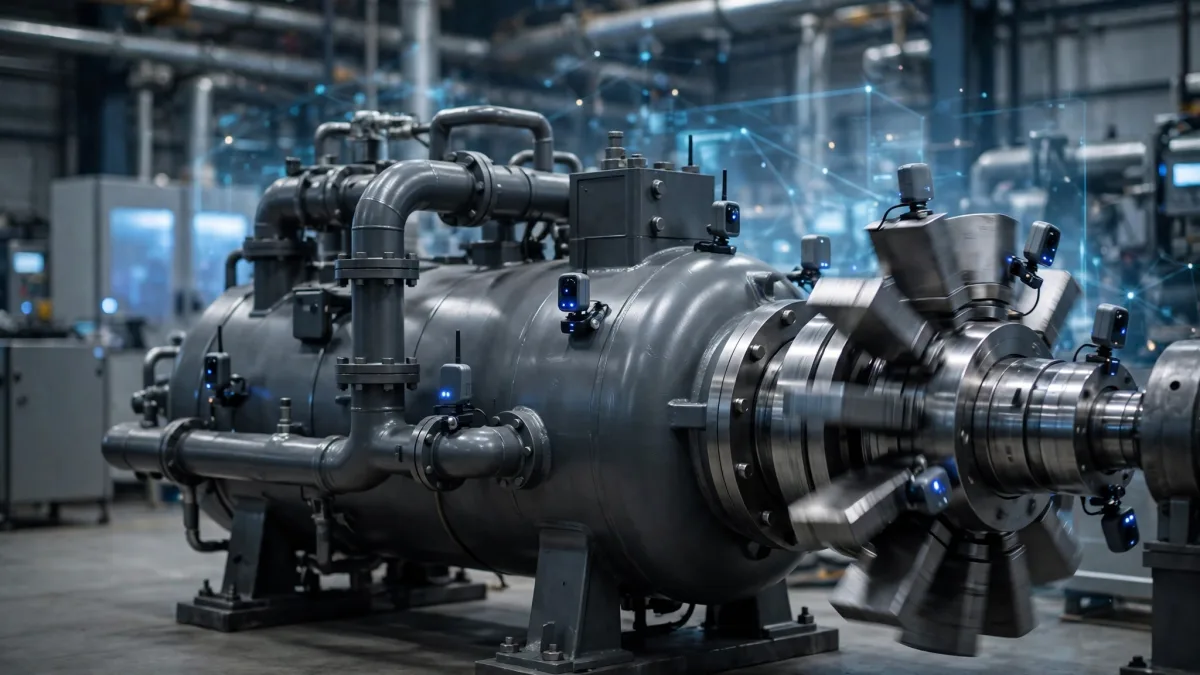
Small vibration, temperature and current sensors give teams days of warning before a critical machine fails, turning emergency shutdowns into planned repairs.
The Short Answer
IoT predictive maintenance turns a machine from a silent risk into a machine that reports on its own health. Instead of waiting for a breakdown, small sensors watch vibration, temperature and electrical current around the clock, and they raise the alarm while a problem is still small enough to plan around. For any business that…
IoT predictive maintenance turns a machine from a silent risk into a machine that reports on its own health. Instead of waiting for a breakdown, small sensors watch vibration, temperature and electrical current around the clock, and they raise the alarm while a problem is still small enough to plan around. For any business that depends on machines to keep work moving, that early warning is the difference between a scheduled repair and a day when everything stops.
Most owners do not need a factory wide system on day one. They need one use case done well: the two or three machines whose failure stops production, spoils stock or leaves a building without cooling, power or compressed air. This guide explains that use case, from sensor to alert, ticket and planned repair.
Why Unplanned Downtime Hurts More Than the Repair Bill
Unplanned downtime is common, frequent and disruptive. In a 2025 Fluke survey of more than 600 senior decision makers and maintenance professionals in the United States, the United Kingdom and Germany, 61 percent of manufacturers said they had suffered unplanned downtime in the past year, and the sector was losing up to 852 million dollars every week. Nearly half of those affected reported 6 to 10 incidents each week, and 45 percent said outages lasted up to 12 hours, with 15 percent reporting incidents stretching to 72 hours.
An ABB study based on a survey of 3,600 senior decision makers found a similar pattern: 44 percent of leaders experienced equipment related interruptions at least monthly, and 14 percent reported stoppages every single week. Most respondents estimated that a sudden disruption costs between 10,000 and 500,000 dollars per hour. Siemens reported in its True Cost of Downtime 2024 study that unplanned downtime costs the Fortune Global 500 about 1.4 trillion dollars a year, around 11 percent of revenue.
The repair bill is only one part of the damage. Missed delivery dates, spoiled stock, idle staff and lost customer confidence all follow from the same stoppage, and a machine that fails without warning tends to fail badly. Early warning moves that work from an emergency into a plan.
How IoT Predictive Maintenance Works
IoT predictive maintenance is a simple loop, repeated continuously. Sensors measure a physical condition. A gateway or network connection carries the readings to software. The software compares each reading against a baseline for that machine, watches for trends over time, and raises an alert when something drifts. A person then decides what to do, and the repair is scheduled before the drift becomes a failure.
The key point is the trend, not a single reading. A machine runs hotter on a warm afternoon, and a motor draws more current at startup. A good system learns what normal looks like for each machine, at different loads and times of day, and only alerts when the pattern changes in a way that matters. That is why predictive maintenance sensors are more useful than a simple on or off alarm. An alarm tells you that a limit has already been crossed. A trend tells you that a limit is being approached, and gives you days or weeks to act.
Three alert levels are worth setting up from the start:
- Warning: a reading has drifted from its baseline and should be watched. The machine goes on a watch list, with no urgent action yet.
- Action: the drift is confirmed over several readings or is accelerating. A maintenance ticket is created and a repair is planned.
- Critical: the reading is close to a level where damage is likely. The machine is inspected promptly and, if needed, taken out of service in a controlled way rather than failing on its own.
Keeping these levels separate matters. If every small change triggers an urgent alarm, staff soon ignore all alarms, and if only a critical alarm exists, the team gets no time to plan.
The Sensors That Do the Warning Work
Most predictive maintenance programmes start with three sensor types, because together they catch the most common failure modes on rotating and powered equipment. Vibration sensors held about 31.4 percent of predictive maintenance sensor revenue in 2025, and temperature sensors followed at about 23.7 percent, according to Dataintelo.
Vibration sensors
Vibration sensors, usually accelerometers mounted on a bearing housing or motor frame, measure how much a machine shakes and at what frequency. When a bearing wears, a shaft misaligns or a coupling loosens, that signature changes, often weeks before the damage is visible or audible. Vibration is the earliest warning for most rotating equipment.
Temperature sensors
Temperature sensors track bearing housings, motor windings, coolant lines and electrical panels. Rising temperature often points to friction, poor lubrication, blocked airflow or an overloaded circuit. Combined with vibration, it is powerful: a bearing that is both vibrating more and running hotter is a much stronger signal than either reading on its own.
Current and power sensors
Current sensors, fitted around a motor supply cable, show how hard a motor is working. A motor that slowly draws more current for the same output may be fighting friction, a partially blocked pump or a degrading winding. Other sensors, such as acoustic, humidity, pressure and oil condition sensors, have their place in phase two.
IoT Predictive Maintenance in Practice: A Compressor Bearing, Week by Week
Imagine a factory air compressor that supplies every pneumatic tool on the line. If it stops, production stops. Its drive end bearing begins to wear, slowly, over about two weeks. Nobody notices at first: the machine sounds the same and output is normal. The sensors, however, are already telling a story.
| When | What the sensors show | What the system does |
|---|---|---|
| Day 1, baseline | Vibration steady, bearing temperature normal, motor current normal | Nothing. The system records the baseline. |
| Day 4 | Vibration up slightly, still inside the normal range | Nothing yet, but the trend line starts to slope upward. |
| Day 8 | Vibration clearly above baseline and rising daily, temperature up a few degrees | Warning alert. The compressor goes on the watch list. |
| Day 11 | Vibration still climbing, temperature rising faster, current draw slightly higher | Action alert. A maintenance ticket is created, with readings attached. |
| Day 13 | All three signals confirm the same story: the bearing is degrading | Repair planned for the next scheduled shutdown. Parts ordered, fitter booked. |
| Day 15, planned shutdown | Bearing replaced in a controlled window, machine back in service the same day | No emergency, no line stoppage, no secondary damage to the shaft. |
Without sensors, the same story ends differently. The bearing keeps wearing unnoticed until it seizes during a production run. The line stops without warning, the shaft may be scored, and parts and a fitter must be found at short notice. The sensors did not prevent wear, because wear is normal. They prevented the surprise, and the surprise is what makes a failure expensive. A single reading is never enough: on day 4, the rise alone could have been a change in load, but by day 11, three signals moving together leave little doubt.
From a Reading to a Repair Ticket
Sensors without a workflow are just numbers on a screen. The value of predictive maintenance sensors comes from what happens automatically the moment a reading drifts. A practical workflow has five steps, and each one should be agreed before the first sensor is fitted.
- Capture: the sensor sends readings at set intervals, and the system stores them against that machine.
- Compare: software compares each reading with the machine baseline and with its own recent trend, not with a generic factory average.
- Alert: when a threshold is crossed, the right person is notified by the channel they actually check.
- Ticket: an action alert creates a maintenance ticket automatically, with the machine name, readings, trend chart and sensor location attached, so the technician arrives informed.
- Close the loop: after the repair, readings are checked again to confirm the machine has returned to baseline. If it has not, the ticket stays open.
Attaching the readings to the ticket matters. A ticket that says "compressor noisy" sends a technician to investigate. A ticket that says "drive end bearing vibration up 40 percent over baseline across seven days, temperature rising, current draw up" sends a technician with the right part and a clear idea of the job. Businesses working with real time data analytics will recognise this pattern: live data is only useful when it triggers a defined next step.
What to Instrument First, and What to Leave for Phase Two
The most common mistake in a first predictive maintenance project is trying to instrument everything. The result is a flood of alerts nobody has time to triage, and a team that loses faith in the system. A better rule is simple: instrument first the machines whose failure stops work.
- The machine that stops the line: the main compressor, the primary pump, the critical conveyor drive or the generator that backs up the site.
- The machine that protects stock or safety: cold storage refrigeration, HVAC for a server room or a large facility, and any backup power system.
- The machine that is already unreliable: the asset with a history of breakdowns, the oldest motor on site, or the unit that maintenance staff already worry about.
Two or three machines, each with vibration, temperature and current monitoring, make a strong phase one. The team learns how alerts behave, baselines settle, and the first planned repair proves the concept. A related overview of IoT use cases for business shows where predictive maintenance sits among other IoT applications, but depth beats breadth here. Phase two can then add more machines, or more sensor types on machines already covered.
Building a Machine Health Dashboard People Actually Check
A dashboard should answer one question at a glance: which machines need attention, and how urgently? Each machine gets a health status, green, amber or red, a short trend line, and a link to its open tickets.
Keep the dashboard where work already happens: a screen in the maintenance office, a daily summary to the operations manager, and mobile access for the on call technician. Review it in the weekly operations meeting, so amber machines are discussed before they turn red. The same thinking behind AI systems that help prevent downtime applies here: early signals, handled by a clear workflow, protect the working day. If you want to apply this approach to your own machines, IoT and embedded systems services can help you choose the right sensors and build the alert to ticket workflow around your most important assets.
Common Mistakes That Undermine a Good Sensor Project
- Setting thresholds too tight: every normal variation becomes an alert, and real warnings get ignored. Start loose, then tighten as baselines settle.
- Monitoring without ownership: if no named person owns each alert level, alerts pile up unread.
- Ignoring the trend: reacting to single spikes wastes visits. Wait for confirmation across readings before creating a ticket.
- Skipping the baseline period: a new sensor needs days or weeks of normal operation to learn what normal is.
- Expecting guarantees: sensors reduce surprises, but they cannot promise that a machine will never fail. Judge a programme on fewer emergencies, not on zero breakdowns.
Frequently Asked Questions
What is IoT predictive maintenance?
IoT predictive maintenance uses connected sensors to monitor a machine condition continuously, for example vibration, temperature and current, and to flag gradual changes that suggest wear. Maintenance is then planned based on the machine actual condition, rather than on a fixed calendar or after a breakdown.
Which sensors are most important for predictive maintenance?
For rotating equipment, vibration sensors are usually first, because they detect bearing wear, misalignment and imbalance early. Temperature sensors add confirmation, since friction and overload raise heat, and current sensors show when a motor is working harder than usual.
How much warning do predictive maintenance sensors give?
Gradual wear such as bearing degradation often shows as a rising trend over days or weeks before failure. Sudden failures, such as a snapped belt, may give little warning, which is why sensors are early warning tools, not guarantees.
Do I need to instrument every machine in my facility?
No. Start with the two or three machines whose failure stops work, spoils stock or removes a critical service. Prove the alert to ticket workflow on those machines first, then expand once the team trusts the alerts.
What happens when a sensor raises an alert?
A warning puts the machine on a watch list. An action alert creates a maintenance ticket with the readings and trend attached, so a repair can be planned. A critical alert prompts prompt inspection and, if needed, a controlled shutdown instead of an uncontrolled failure.
Can predictive maintenance replace routine servicing?
No, it complements it. Routine servicing still covers lubrication, cleaning, inspection and consumables. Predictive monitoring adds condition insight between services, so developing faults are caught before they become emergencies.
If unplanned stops are disrupting your operation, start with your most critical machines and a clear alert to repair workflow. Contact Skills Technology Solutions to discuss a practical IoT predictive maintenance setup for your facility.
Related Articles
Keep reading — more guides you may find useful.



Related Services
Services connected to this guide.