
Super Apps vs Focused Apps: Choosing Your Mobile Strategy
Should your business build one all-in-one super app or several focused apps? This guide compares retention, discovery, maintenance, and trust, then gives you a clear framework for choosing the mobile model that fits your services and users.
Key Takeaways
- A super app suits services people use together every day under one login.
- Focused apps win when one task deserves full attention and a clear identity.
- Start with one strong service, then expand only when users ask for more.
- Discovery, maintenance, and trust decide the winner more than feature count.
Choose a super app when your services naturally belong together and repeat use keeps people coming back daily, and choose focused apps when each service serves a distinct audience or needs its own identity. That is the core of a super app vs focused app strategy: match the app model to how people actually use your services, not to which model looks more ambitious. This article compares the two models side by side, explains where each one wins, and gives you a practical framework for deciding which path fits your business and your long term plans.
What Is a Super App?
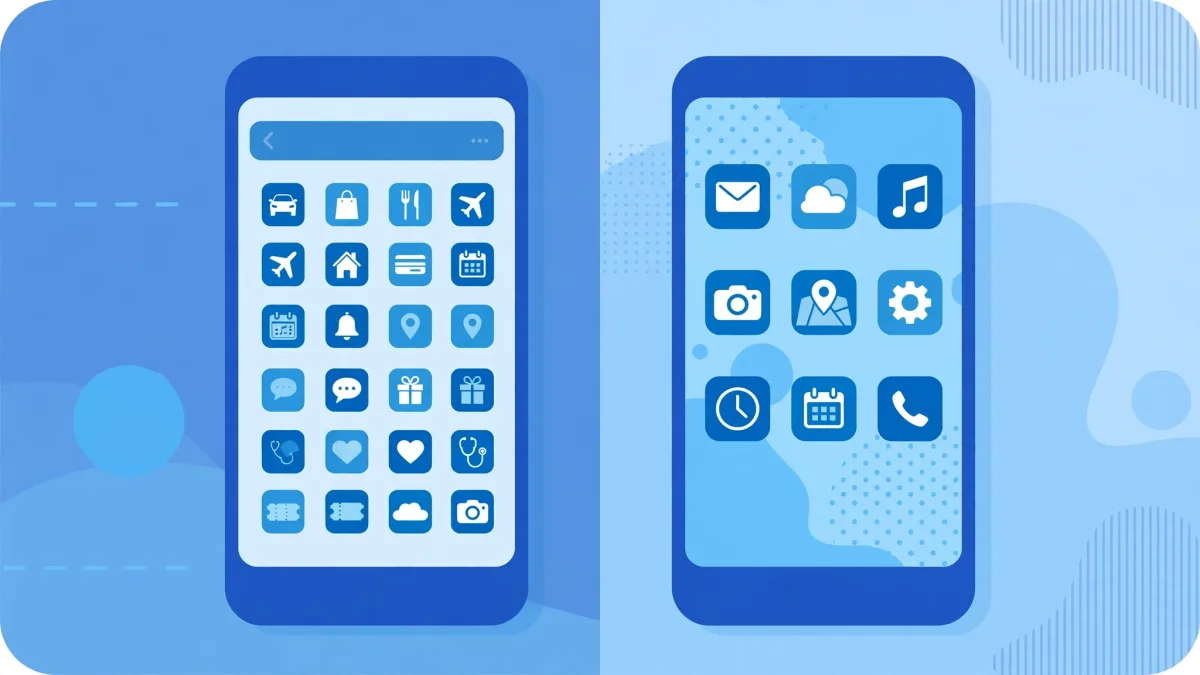
A super app is a single mobile application that brings several related services together behind one login, one profile, and one set of shared tools such as messaging, maps, and payments. Instead of opening a different app for every task, the user opens one app and moves between services inside it. WeChat is the best known example, combining messaging, payments, shopping, bookings, and thousands of small mini programs in one place. Grab and Gojek follow the same pattern across Southeast Asia, pairing rides and deliveries with payments and financial services, while Careem does the same across the Middle East with rides, deliveries, and everyday services. In Europe, Revolut grew from a travel money tool into a financial super app that now covers accounts, transfers, trading, savings, and insurance. According to Gartner, by 2027 more than 50 percent of the global population will be daily active users of multiple super apps. That forecast shows how far the model has travelled beyond its early home in Asia. A super app works best when the services inside it share the same users and the same daily routines. A ride hailing service and a food delivery service fit together because the same person needs both in the same week. A messaging app and a payment tool fit together because people send money to the same contacts they chat with. The connection must feel natural, because users notice at once when unrelated services are forced into one home screen.
What Is a Focused App?
A focused app is a mobile application built to do one job extremely well. It opens fast, it explains itself in seconds, and every screen serves the same single purpose. Duolingo is a clear example: it teaches languages and nothing else, and its whole design supports daily practice. A dedicated fitness tracker or a food delivery app that only delivers food follows the same idea. The user downloads the app for one reason, and the app never asks them to do anything else. Focused apps are easier to understand, easier to test, and easier to improve, because every change serves one clear goal. They also stand out more clearly in app store search, since the app name, description, and reviews all point at the same single promise. For a business, a focused app keeps the team aligned: designers, developers, and support staff all work on the same experience instead of splitting attention across many services.
How Does a Super App vs Focused App Strategy Work?
A super app vs focused app strategy works by choosing the app model that matches how your users behave, then building the product and the team around that choice. A super app strategy starts with one strong anchor service that brings users in every day, such as messaging, rides, or payments, and then adds related services one at a time so each new service inherits the existing audience. A focused app strategy does the opposite: it keeps the product narrow, deepens the single experience, and grows by reaching new users rather than by adding new services. Many successful super apps began as focused apps. Revolut started with one travel money feature, built a large audience around it, and only then added the services that turned it into a financial platform. According to Revolut, the company passed 70 million customers in January 2026, up from 50 million in November 2024, after adding 16 million new customers in 2025. That growth shows how a single strong starting point can support steady expansion when each addition earns its place. Under the surface, a super app needs a shared identity system, a shared payment layer, and a modular design so each service can be updated without breaking the others. A focused app needs far less shared infrastructure, which is why it can move faster in the early stages. Either way, the technical plan should follow the business decision, not lead it, and a clear mobile app development plan helps a team choose the right architecture for the model they pick.
What Are the Strengths of a Super App?
A super app is strong because it keeps users inside one place for longer and gives every new service a ready made audience. Once a person trusts the app with their login and payment details, trying a second service inside the same app takes almost no effort, so a new service does not need to win a fresh download. The shared profile also makes the experience smoother, since addresses, preferences, and history carry across services without the user entering them again. According to Grab, the company averaged 47.2 million monthly transacting users in its 2025 financial year and reached 129 million annual transacting users, showing how a super app can turn one audience into many kinds of activity. According to Tencent, the combined monthly active accounts of Weixin and WeChat reached 1,432 million in the first quarter of 2026, which shows the scale a mature super app can reach when its services become part of daily life.
What Are the Strengths of a Focused App?
A focused app is strong because it is simple, fast, and clear about what it does. Users open it with one goal in mind, complete that goal without distraction, and leave satisfied. That clarity builds trust quickly, especially for services where accuracy matters, such as banking, health, or learning. A focused app is also easier to keep excellent over time, since each update improves the same experience and feedback points at the same screens. App store visibility is another advantage: a focused app can rank for the exact words its audience searches for, and every review reinforces the same promise. Our guide to app store optimisation in 2026 explains how a clear single purpose listing helps an app get found and downloaded. A focused app also limits risk: if one service has a problem, it stays inside that app instead of affecting every other service the business offers.
Super Apps vs Focused Apps: The Key Trade-Offs
The choice comes down to trade offs that pull in opposite directions, and the table below puts them side by side so the decision is easier to weigh.
| Factor | Super App | Focused App |
|---|---|---|
| Discovery | New services reach the existing audience at once | Each app must win its own downloads and attention |
| User experience | One login and shared data across services | One clear task with no distractions |
| Speed to launch | Slower, because shared systems come first | Faster, because the scope is narrow |
| Maintenance | One app to update, but changes affect all services | Each app is simple, but several apps mean several updates |
| Trust and safety | One breach or outage affects every service | Problems stay contained in one app |
| Brand clarity | One strong brand for many services | Each service keeps its own clear identity |
| Growth path | Grows by adding services to the same audience | Grows by reaching new users for the same service |
Neither column is better in every row. A super app trades simplicity for reach, while a focused app trades reach for clarity. The right answer depends on which trade offs your users will accept and which ones they will punish. Teams comparing frameworks for either model can also read our Flutter vs React Native guide to understand how the underlying technology choice affects both paths.
Which Super App vs Focused App Strategy Should You Choose?
Your super app vs focused app strategy should follow four questions about your users, your services, and your team. First, do your services share the same people and the same daily routine? If the same user needs rides, food, and payments in the same week, a super app fits. If each service serves a different audience, separate apps keep each one clear. Second, do you already have one service people use often? A super app needs a strong anchor service to pull users in daily; without one, the extra services sit unseen. Third, can your team support the complexity? A super app needs shared identity, shared payments, and careful coordination between service teams, while focused apps let small teams move independently. Fourth, how much do your users value simplicity over convenience? A hybrid path is also possible: start with a focused app, prove the core service, and add related services only when users ask for them and the anchor audience is strong. That staged approach is how many of the best known super apps actually grew, and it avoids the most common failure, which is launching a wide platform before any single service is strong enough to attract users. Design matters at every stage, and thoughtful UI UX design keeps a growing app easy to navigate instead of letting new services bury the features people use most.
What Are the Common Mistakes in Choosing a Mobile Strategy?
The most common mistake is building a super app before any single service is strong enough to attract users on its own. A platform with five weak services loses to one excellent focused app every time, because users download apps for the service, not for the platform idea. Another mistake is adding services that do not belong together. When a food delivery app adds unrelated tools, users get confused, the home screen gets crowded, and the core service suffers. A third mistake is hiding the core service behind menus and promotions for newer services, which frustrates the loyal users who made the app successful in the first place. Security and compliance deserve attention too: a super app holds more kinds of personal data in one place, so a single weakness affects every service, and each new service can bring its own rules for handling payments, health data, or location data. Finally, many businesses copy a famous super app without asking whether their market behaves the same way. WeChat grew in a market where messaging, payments, and daily services converged early, and that pattern does not repeat everywhere.
Frequently Asked Questions
Can a business start with a focused app and grow into a super app?
Yes, a focused app can grow into a super app, and this is the safest path for most businesses. Launch one strong service first, build a loyal audience around it, and add related services only when users ask for them. Each addition should share the same users and daily routine as the anchor service.
Do users prefer super apps or focused apps?
Users prefer whichever model makes their task easier, and the answer changes by market and by service. Super apps win where people use several related services every day, while focused apps win where one task deserves full attention. The best choice follows real user behaviour rather than trends.
How many services should a super app include at launch?
A super app should launch with one strong anchor service and at most one or two closely related services. Each service must be good enough to attract users on its own merit. Adding more services before the anchor is proven spreads the team thin and confuses new users.
Is a super app harder to maintain than a focused app?
Yes, a super app is harder to maintain because its services share identity, payments, and data systems, so one change can affect everything. A focused app is simpler to update and test. A super app needs modular design and careful coordination so each service team can work without blocking the others.
What is the best mobile strategy for a small business?
A small business should usually start with one focused app that serves its best service and its clearest audience. A focused app is faster to launch, easier to explain, and simpler to keep excellent. A super app only makes sense once that first service has a loyal daily audience asking for more.
Choosing between a super app and focused apps is a decision about your users, not about fashion. Build one app when your services belong together, build focused apps when each service deserves its own stage, and grow in stages so every addition earns its place. Skills Technology Solutions, a software agency based in Rahim Yar Khan, Pakistan, serving clients in Pakistan and the UK, can help you put this into practice. Contact our team to discuss your project.
Related Articles
Keep reading — more guides you may find useful.


Related Services
Services connected to this guide.