
How to Choose a UI/UX Design Agency in 2026
Learn how to choose a UI/UX design agency in 2026. Compare portfolios, process, research methods, deliverables, and red flags before you sign.
The Short Answer
Choosing a UI/UX design agency is one of the highest leverage decisions a business can make in 2026. Your website or app is often the first place a potential customer meets your brand, and within seconds that visitor decides whether to stay and buy, or leave and never come back. A strong design partner shapes…
Choosing a UI/UX design agency is one of the highest leverage decisions a business can make in 2026. Your website or app is often the first place a potential customer meets your brand, and within seconds that visitor decides whether to stay and buy, or leave and never come back. A strong design partner shapes that first impression and every interaction that follows. A weak one can leave you with beautiful screens that confuse users and stall conversions.
This guide shows how to choose a UI/UX design agency with confidence: what a good agency delivers, how to evaluate portfolios and proposals, which research methods matter, which red flags should make you walk away, and which questions to ask before you sign.
Why Choosing the Right UI/UX Design Agency Matters
Design is not decoration. It is the system that guides a visitor from landing on your site to completing the action you want, whether that is a purchase, a signup, or an enquiry. Every button placement, form field, navigation label, and page layout either removes friction or adds it. Research shows that 88% of users are less likely to return to a site after a poor user experience.
The upside is just as dramatic. Research widely attributed to Forrester finds that a well-designed user interface can increase conversion rates by up to 200%, while strong end-to-end user experience work can lift conversions by up to 400%. McKinsey found that companies in the top quartile for design performance grew revenue 32 percentage points faster than their industry peers over five years.
The stakes are especially high in eCommerce and SaaS. Baymard Institute research puts the global average cart abandonment rate at 70.19%, and its analysis shows that better checkout UX alone can deliver a conversion lift of around 35.26% for large eCommerce sites. A capable agency fixes these problems at the root by understanding your users, not by rearranging pixels.
What a Good UI/UX Design Agency Actually Delivers
Before you evaluate any agency, get clear on what you are buying. A professional UI/UX design service covers far more than mockups. It covers research, strategy, interaction design, visual design, testing, and handoff, all tied to measurable business outcomes.
A full engagement typically includes:
- User research: interviews, surveys, analytics reviews, and usability testing that reveal what users need and what stops them converting.
- Information architecture: a clear structure, including sitemaps, navigation, and content hierarchy, so users find what they need without guessing.
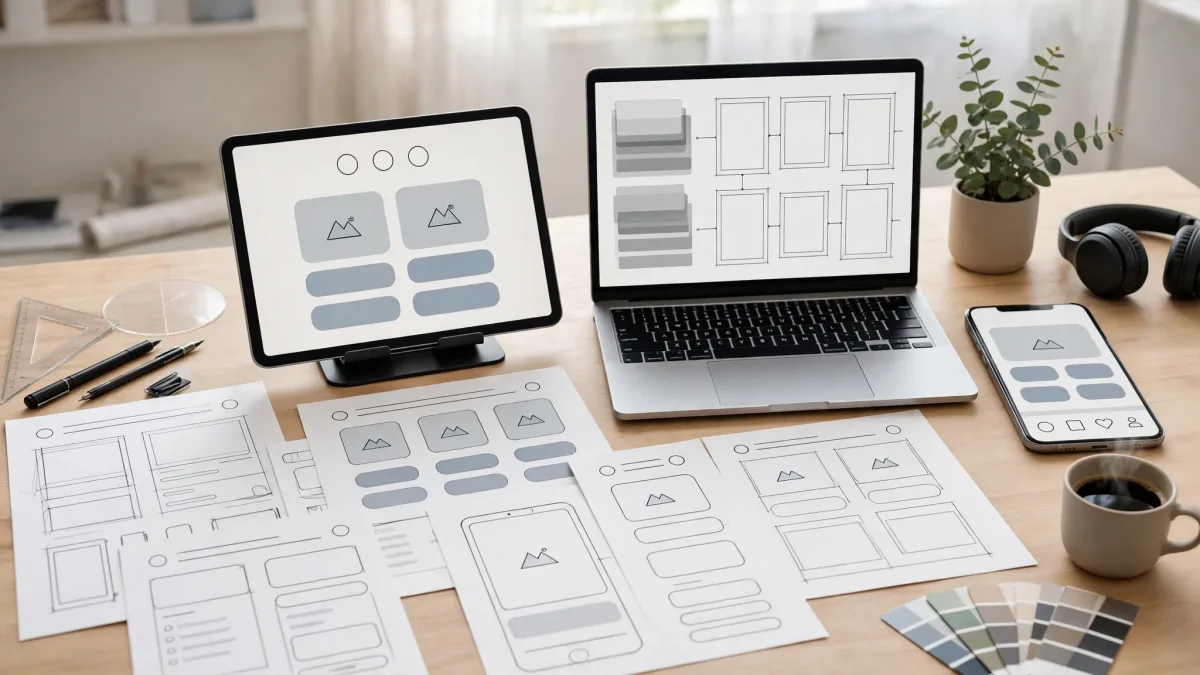
- Wireframes and prototypes: layouts that test structure and flow, plus interactive prototypes real users try before production code is written.
- Visual UI design: polished screens built on a consistent design system, with defined colors, typography, components, and spacing.
- Usability testing: sessions where real users complete real tasks, so decisions are validated by evidence, not opinions.
- Developer-ready handoff: annotated files, component libraries, design tokens, and documentation your team can build from without guesswork.
- Post-launch iteration: measurement against agreed metrics, then refinements based on real user behavior.
If an agency offers only polished screens with no research, testing, or handoff documentation, you are buying decoration, not design.
How to Evaluate a UI/UX Design Agency: The Checklist
Use this checklist to compare every candidate on the same criteria. Do not let a single stunning portfolio piece override weaknesses elsewhere.
1. Portfolio depth, not just portfolio beauty
Look past the screenshots. A strong case study explains the problem, the constraints, the users, the decisions, and the outcome. Ask what was broken before, what the agency changed, and what happened after launch. Look for two or three projects in your industry or a closely related one, such as SaaS, fintech, eCommerce, or healthcare.
2. A documented, repeatable process
Ask every candidate to walk you through their process from brief to delivery. A mature agency can describe each phase, what happens in it, who is involved, what you receive, and where you make decisions. A typical process runs through discovery, research, wireframing, prototyping, visual design, testing, handoff, and iteration. Be wary of any agency that jumps straight to visual design.
3. Real user research methods
Research is where strong agencies separate from weak ones. Credible methods include user interviews, surveys, heuristic evaluations, card sorting, journey mapping, usability testing, and analytics analysis. The agency should be able to tell you how many interviews or test sessions are included, and show sample artifacts such as personas or test reports. For a closer look at what goes wrong when research is skipped, read our guide to 10 UX design mistakes that kill conversions.
4. Team composition and seniority
Ask who will actually work on your project, by name and role. A complete team usually includes a UX researcher, a UX designer, a UI designer, and someone who owns the design system. Confirm whether the senior people who pitch the project are the same people who will deliver it. The classic bait-and-switch, where senior partners sell the work and juniors you have never met deliver it, is one of the most common complaints about agency engagements. Also ask how designers collaborate with developers, since close collaboration prevents the common outcome where designs look great in Figma but are impractical to build.
5. Deliverables spelled out in writing
"Screens and assets" is not a scope. Before you sign, get a specific deliverables list: how many screens, which user flows, which states and edge cases, whether a design system is included, what documentation accompanies handoff, and which file formats you receive. Confirm who owns the source files and the design system at the end of the engagement, and whether the agency supports your developers during build and reviews the implemented product against the designs.
6. Communication, accessibility, and measurement
Design is collaborative, so communication quality predicts project quality. Ask how often you will meet, which tools the team uses, who your day-to-day contact is, and how feedback is tracked. On accessibility, ask how the agency designs for WCAG compliance, including color contrast, keyboard navigation, focus states, readable typography, and alt text. Any agency that treats accessibility as optional is a liability. On measurement, strong agencies define success metrics before design begins, such as conversion rate, task completion, signup completion, or retention, and report against them after launch.
Red Flags That Should Make You Walk Away
Watch for these patterns:
- No discovery or research phase in the proposal. Design without research is guesswork. If the proposal jumps straight to UI design, the agency is decorating, not solving.
- Portfolio without context. Beautiful screenshots with no explanation of the problem, the users, the constraints, or the outcome are not evidence of capability.
- Vague deliverables. If the agency cannot list exactly what you will receive, scope disputes are almost guaranteed.
- Everything is a yes. A partner who never pushes back on your requirements is not a partner. Good agencies challenge assumptions, because stakeholder requirements are frequently wrong about what users actually need.
- "We move fast" with no research timeline. Speed before discovery produces interfaces that look finished and fail real users.
- No mention of your users. If the first meeting is all about the agency and its tools, with no questions about who your users are, the agency is selling, not listening.
- Template dependence. Overreliance on UI kits without evidence of custom design thinking suggests you will get a generic product, not one shaped around your users.
- No post-launch interest. If the agency has no plan for what happens after launch, they are not accountable for whether the design actually works.
If you spot one red flag, dig deeper. If you spot two or more, keep searching.
Questions to Ask a UI/UX Design Agency Before Signing
Take these questions into every discovery call. Strong agencies answer with specifics.
- Can you walk us through a recent project from brief to delivery, including the research, the decisions, and the measured outcome?
- Which research methods will you use on our project, and how many interviews or usability sessions are included?
- Who, by name, will work on our project daily, and how much of the work is done by senior designers?
- What exactly will we receive at handoff? Is a design system, documentation, and developer support included?
- How do you handle feedback, revisions, and scope changes? What happens if we disagree with a design direction?
- How do you collaborate with our developers or product team during the build?
- How do you design for accessibility, and which standards do you test against?
- What metrics will define success for this engagement, and how will you report on them after launch?
- Can we speak with two or three past clients in a similar industry or product category?
- What happens after launch? Do you offer iteration, usability checks, or ongoing design support?
Pay close attention to the first call. The best agencies spend it listening and asking clarifying questions about your business, your users, and your goals.
How to Compare Proposals Without Comparing Apples to Oranges
Proposals are hard to compare because agencies package their work differently. One may include research, testing, and a design system. Another may cover screens only. Comparing those two on headline terms alone is meaningless, so normalize every proposal before you compare it.
First, build a simple scorecard using the checklist above. Score each agency from 1 to 5 on research, process, portfolio relevance, team seniority, deliverables, communication, accessibility, and measurement. Weight research and measurement most heavily, because those two factors predict whether the engagement will improve your business results. Second, compare scope line by line, confirm that each proposal covers the same phases and deliverables, and get clarifications in writing.
Third, run a small paid pilot before committing to a full engagement. A UX audit of one user flow or a redesign of a single critical screen is a low-risk way to test real output quality, communication speed, and thinking depth. Fourth, check references properly. Ask past clients about timeline accuracy, how the agency handled disagreements, whether the handoff was clean, and whether they would hire the agency again.
Finally, pick the engagement model that fits your situation. A fixed-scope project works well when the problem is clearly defined. A dedicated team or retainer fits better when you need continuous product design over months. A short audit or sprint fits when you need to diagnose a specific problem, such as a checkout drop-off, before committing to a larger redesign. If you are planning a full rebuild, read our website redesign checklist for 2026 before you scope the work. If your product is a mobile app, the evaluation principles are similar to those in our guide on how to choose a mobile app development company in 2026.
Frequently Asked Questions
How long does a typical UI/UX design engagement take?
It depends on scope. A focused UX audit or single-flow improvement typically takes two to four weeks. A new product or MVP design usually takes two to three months. A complex platform with multiple user roles takes longer. Any timeline that skips discovery and research should be treated with suspicion.
Should we hire an agency, a freelancer, or build an in-house team?
An agency is usually the right choice when you need fast execution, a full multidisciplinary team, and specialist skills such as research and design systems without the hiring overhead. A freelancer works well for a focused, well-defined task. An in-house team makes sense when design is a continuous, long-term need. Many businesses combine models, using an agency for major design work and in-house designers for day-to-day iteration.
What should we prepare before contacting an agency?
Prepare a short brief covering your business goals, your target users, the product in question, the problem you want to solve, your timeline, and how you will measure success. Share analytics and examples of products you admire. You do not need a finished specification.
How do we know if the agency understands our industry?
Look for case studies in your industry or an adjacent one, and listen to how the agency talks about your users during the first call. Do they ask about your customers, their goals, and their constraints? An agency that understands your industry will ask sharper questions and surface risks you had not considered.
What if we already have developers? Can the agency work with them?
Yes, and this is a common setup. Ask how the agency collaborates with external development teams, how handoff is documented, and whether they review the implemented product against the designs. Design quality only matters if what ships matches what was designed.
How do we measure whether the redesign worked?
Agree on metrics before design begins, then measure before and after launch. Useful metrics include conversion rate, signup or checkout completion, task completion rate, time on task, retention, and support ticket volume. Combine quantitative data with qualitative feedback from usability testing and user interviews.
Choosing the right design partner takes a few weeks of disciplined evaluation, but it saves months of rework. Shortlist on evidence, not on pitch decks. Demand research, clear deliverables, senior people, and measurable outcomes.
Ready to find a design partner who starts with your users and ends with measurable results? Contact our team to discuss your product, your goals, and how thoughtful UI/UX design can lift your conversions.
Related Articles
Keep reading — more guides you may find useful.
Related Services
Services connected to this guide.