
Headless Commerce: Build a Faster Online Store 2026
Headless commerce separates your storefront from your commerce engine, so one backend can power a fast website, app, and kiosk. Learn when it pays off and how to migrate without losing SEO.
The Short Answer
Headless commerce is changing how growing online stores are built in 2026. Instead of one locked system controlling both what shoppers see and how orders are processed, it separates the front-end presentation layer from the back-end commerce engine. The two layers talk through APIs, so each side can be updated without rebuilding the whole store.
Headless commerce is changing how growing online stores are built in 2026. Instead of one locked system controlling both what shoppers see and how orders are processed, it separates the front-end presentation layer from the back-end commerce engine. The two layers talk through APIs, so each side can be updated without rebuilding the whole store.
This guide explains what headless commerce means, why it is growing in 2026, how it affects speed and search rankings, and how to decide whether it fits your store.
What Headless Commerce Actually Means
In a traditional online store, the storefront and the commerce logic live in one tightly connected system. The theme controls the layout, checkout, and product pages, while the platform controls inventory, pricing, orders, and payments in the same package. That setup is simple to launch and works well for many small stores. The problem appears when the store grows and every change, from a new landing page to a wholesale catalog, has to fit inside the platform's template rules.
Headless commerce removes that constraint. The back end becomes a commerce engine managing products, inventory, pricing, customers, orders, and payments. The front end becomes an experience layer built with any modern framework, such as Next.js, Nuxt, or React, that pulls data through APIs. When a customer opens a product page, the front end requests product data and displays it in the brand's own layout. At checkout, the front end sends the order back through the API, and the back end processes payment and inventory.
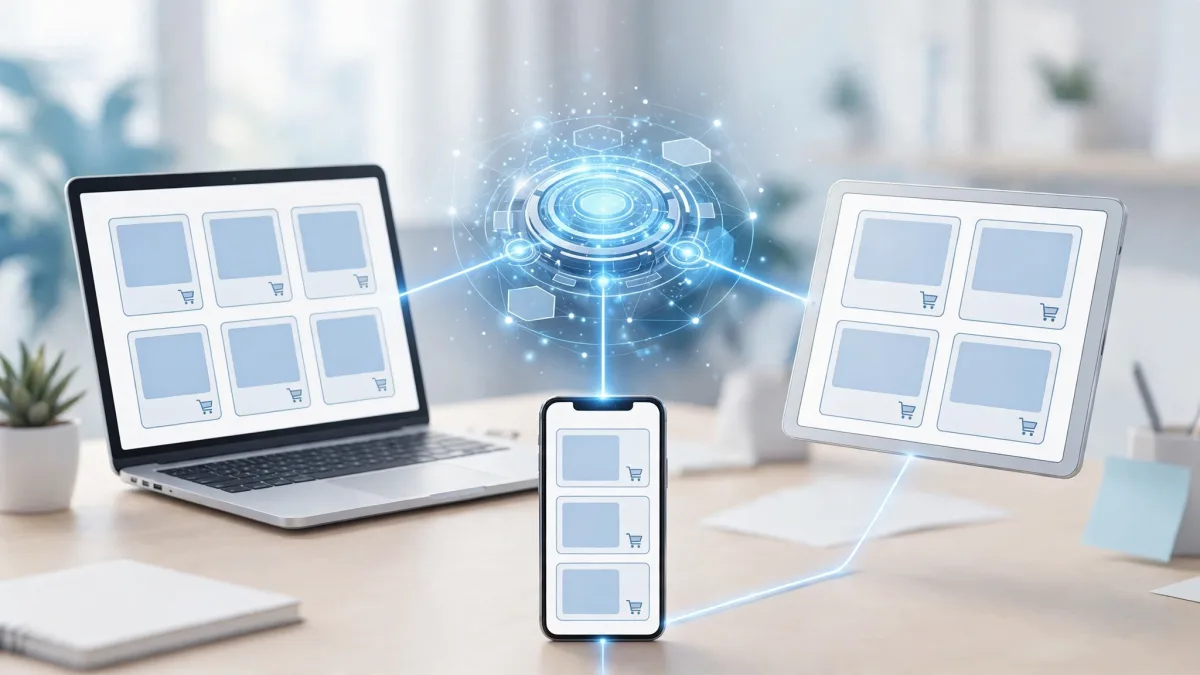
Headless commerce separates the storefront shoppers see from the commerce engine behind it, and the two connect through APIs. That separation is the whole idea: the back end manages products, inventory, pricing, orders, and payments, while the front end can be designed freely for each channel.
Why Headless Commerce Is Growing in 2026
Headless commerce is moving from an enterprise experiment to a mainstream option for mid-sized stores.
First, shoppers move between channels without thinking about it: they discover a product on social media, compare it on a phone, and finish the purchase on a laptop. Headless lets one backend serve every channel with an experience designed for that channel.
Second, speed has become a competitive weapon. Research widely cited in the ecommerce industry finds that 64 percent of smartphone users expect pages to load in under four seconds, and 40 percent will leave a page that takes more than three seconds. A headless front end built with modern frameworks can be leaner than a heavy theme, because it loads only what each page needs.
Third, marketing teams want to move faster. In a coupled store, a new campaign page or a test of a different product page design often waits in a development queue because the change touches the platform theme. In a headless setup, the front-end team can ship design and content changes on its own schedule, while the commerce team keeps the back end stable.
Fourth, the market itself is expanding quickly. Coherent Market Insights estimates that the global headless commerce market will grow from 2.13 billion dollars in 2026 to 7.24 billion dollars by 2033. That growth reflects more platforms, better tooling, and more agencies with real headless experience.
Finally, artificial intelligence is reshaping how people shop. In 2026, AI shopping agents increasingly browse, compare, and even buy on behalf of customers. Those agents depend on structured product data and fast API responses, which a headless storefront delivers natively. Our guide to how AI agents are changing ecommerce explains why that machine-readable layer matters more every year.
Headless Commerce Performance: Speed, SEO, and Core Web Vitals
Headless gives you the tools to build a fast, search-friendly storefront, but you still have to use them well. Here is how the performance story actually works.
Faster pages through modern front-end techniques
A headless front end can use server-side rendering, static generation, image optimization, and edge caching in ways that many traditional themes cannot. Server-side rendering means the server sends a fully formed page to the browser, so shoppers see content sooner. Static generation pre-builds pages that rarely change, so they can be served instantly from a content delivery network. Together, these techniques can produce strong Core Web Vitals scores, the loading, interactivity, and visual stability metrics Google uses as part of its ranking signals.
Better crawlability for search engines
Headless stores built with server-side rendering deliver pre-rendered HTML to search engines, which improves crawlability. That matters because some JavaScript-heavy storefronts make crawlers work hard to discover content. Pre-rendered HTML avoids that problem by presenting the finished page up front. Structured data for products, prices, availability, reviews, and breadcrumbs should still be added deliberately, because headless does not generate it by itself.
What headless does not fix on its own
Going headless does not guarantee good SEO or speed. A poorly built headless front end can be slower than a well-tuned traditional theme, and a migration that changes URLs without redirects can damage rankings. Canonical tags, meta descriptions, redirect maps, and sitemap handling all need explicit attention during a headless rebuild.
One Backend, Many Storefronts: A Worked Example
The clearest way to judge headless is to see it in action. Consider a growing home goods retailer with 400 products, a website, a mobile app, and a new showroom. Before headless, the retailer ran a standard themed store. Every change to the homepage had to pass through the theme, and the mobile app showed a simplified copy of the website.
After moving to headless, the same commerce backend powers three different front ends:
- Website: a content-rich storefront with buying guides, room collections, and a fast, custom product page.
- Mobile app: a compact experience with saved rooms, barcode scanning, and one-tap reordering, using the same APIs so prices and stock always agree.
- Showroom kiosk: a large touch screen showing live stock, colors, and sizes, sending orders to the same checkout and inventory system.
When the retailer runs a seasonal sale, the team changes the price rules once in the backend, and all three front ends reflect the new prices immediately. When the design team wants to test a new product page layout, it tests on the website only, without risking the app or the kiosk. That is the practical payoff of headless: one source of truth for commerce, many tailored ways to sell.
Building this kind of setup is an ecommerce development project, not a theme install. A team experienced in API development and integration can design those connections so product data, pricing, and inventory stay consistent across every channel.
Headless Commerce vs Traditional Commerce
The table below compares the two architectures on the factors that matter most to a growing store.
| Factor | Traditional Commerce | Headless Commerce |
|---|---|---|
| Front-end flexibility | Limited by theme and template rules | Full control with any modern framework |
| Speed optimization | Constrained by platform theme code | Fine-grained control over rendering and caching |
| Omnichannel selling | Hard to tailor per channel | One backend serves web, app, kiosk, and more |
| Content and campaign speed | Changes often wait on theme work | Front-end team ships independently |
| Third-party integrations | Plugin and app marketplace | API-first, but each integration must be wired up |
| Team and skills needed | Lower, platform skills suffice | Higher, front-end and API skills required |
| Best fit | Small stores, simple catalogs, standard needs | Growing stores, custom UX, multiple channels |
The right choice depends on the store's size, growth plans, and the complexity of the experience it needs to deliver.
Should Your Store Go Headless? A Decision Framework
Headless is not for every store. A small store on a standard plan with no advanced customization needs is usually better served by a traditional platform, where the theme, checkout, apps, and hosting are handled in one place. Use the five-question framework below to make the call honestly.
1. Have you hit the limits of your theme more than once?
If your team has repeatedly been told that a layout, checkout flow, or product experience is not possible in your current theme, that is a signal. A pattern of blocked requests means the architecture, not the theme, is the bottleneck.
2. Do you sell, or plan to sell, on more than one channel?
If the website is the only channel and will stay that way, headless adds complexity for little gain. If you run or plan a mobile app, marketplace presence, kiosk, or B2B portal, headless gives each channel its own experience on shared commerce data.
3. Is speed a measurable drag on conversions?
If mobile bounce rates are high, Core Web Vitals are poor, and load times exceed what shoppers expect, a headless rebuild can be justified on performance alone. If your store is already fast and well tuned, the performance case is weaker.
4. Does your team have, or can it hire, front-end and API skills?
A headless store needs developers who can build and maintain a modern front end and manage APIs. If that capability is not available, budget for a development partner or stay with a traditional platform.
5. Is the investment horizon at least 12 to 24 months?
Headless is a multi-year investment: performance gains compound as rankings improve, and conversion gains appear over months, not days. If the store needs a quick fix this quarter, tune the current platform first. For a full pre-rebuild review, see our website redesign checklist for 2026.
If you answered yes to three or more, headless deserves a serious evaluation. Otherwise, stay on your current platform and invest in optimization.
How to Migrate to Headless Commerce Without Breaking SEO
A headless migration rebuilds the storefront while the backend usually stays in place. That makes a careful migration possible, but only with a disciplined sequence.
- Audit first: record every URL, meta title, meta description, and top landing page before work begins, and export analytics data for before-and-after comparison.
- Freeze the URL structure: keep URLs the same wherever possible, and map every changed URL to its new equivalent with a permanent 301 redirect.
- Build the front end with SEO built in: confirm server-side rendering or static generation, canonical tags, meta fields, structured data, and sitemaps before launch. See our API integration guide for 2026 for a deeper look at connecting systems cleanly.
- Test checkout end to end: test payments, discounts, shipping, inventory updates, and order emails on staging.
- Launch in stages: release one section first, monitor rankings and conversions, then roll out the rest.
- Monitor after launch: watch Core Web Vitals, crawl errors, rankings, and conversions daily for the first weeks, and keep redirects live for months.
One more lesson: in a traditional store, many features come from plugins that render inside the theme. In a headless store, every storefront-facing feature, from reviews to live chat, must expose its data through an API or SDK. Audit every app before migration and confirm headless support.
Frequently Asked Questions About Headless Commerce
What is headless commerce in simple terms?
Headless commerce separates the part of the store shoppers see from the part that handles products, orders, and payments. The storefront and the commerce engine connect through APIs, so each side can change independently, and one backend can power a website, an app, and other channels at the same time.
Is headless commerce better for SEO?
It can be, when built well. Server-side rendering delivers pre-rendered HTML to search engines, improving crawlability, and modern front-end techniques can improve Core Web Vitals. But SEO still depends on correct URLs, redirects, meta data, and structured data, so SEO must be part of the project from day one.
Does headless commerce work for B2B stores?
Yes, and B2B is often a strong fit. Headless handles custom pricing tiers, account-based catalogs, quote requests, approval workflows, and ERP connections cleanly through APIs. B2B stores with complex checkout flows should migrate progressively rather than replacing the whole storefront at once.
How long does a headless migration take?
It varies with catalog size, channel count, and customization, but a typical mid-sized headless rebuild takes several months from planning to launch. Teams should plan for design, development, integration, testing, and a staged launch.
Can I migrate to headless without losing search rankings?
Yes, if the migration preserves URLs, maps every changed URL with a 301 redirect, keeps meta and structured data intact, and uses server-side rendering or static generation. Monitor rankings closely after launch so any dip can be fixed quickly.
Do I still need a commerce platform with headless?
Yes. Headless replaces the storefront, not the commerce engine. You still need a backend platform, such as Shopify Plus, BigCommerce, Adobe Commerce, or commercetools, to manage products, inventory, pricing, orders, and payments.
Headless commerce gives growing stores something a template cannot: the freedom to design the exact experience each channel needs, on top of one reliable commerce engine. It is not right for every store, and it demands real development capability, but for stores that have outgrown their theme or sell on multiple channels, it is the architecture that makes the next stage of growth possible. To talk through the right architecture for your store, contact our team and we will help you map the next step.
Related Articles
Keep reading — more guides you may find useful.
Related Services
Services connected to this guide.