
Faster Game Development Pipelines: What Studios Must Fix in 2026
Rockstar says its next game will not take eight years. Here is what reusable tooling, AI pipelines, and scope discipline mean for studios and buyers.
The Short Answer
In 2026, faster game development is a competitive advantage in games. It means shipping while a genre is hot, keeping a team together between projects, and giving players a reason to pay attention before they move on. In October 2026, Rockstar Games made that point better than any analyst could. Its leaders told Bloomberg that…
In 2026, faster game development is a competitive advantage in games. It means shipping while a genre is hot, keeping a team together between projects, and giving players a reason to pay attention before they move on. In October 2026, Rockstar Games made that point better than any analyst could. Its leaders told Bloomberg that the studio's next game after Grand Theft Auto 6 will not take another eight years to make. The reason was not a bigger team or longer hours. It was a pipeline: the engine, the tools, and the team built during GTA 6 will carry straight into the next project instead of being rebuilt from scratch.
That statement matters far beyond one studio. Speed rarely comes from rushing. It comes from foundations that survive from one project to the next, from automation that removes repetitive work, and from scope discipline that keeps a game shippable. This guide explains what shorter pipelines mean in practice, for studios building games and for publishers and brands buying game development work.
What Rockstar Actually Said, and Why It Matters
Grand Theft Auto 6 launches on November 19, 2026, eight years after Rockstar's previous major release, Red Dead Redemption 2, which arrived in October 2018. In a Bloomberg feature on the making of GTA 6, development heads Phil Hooker and Aaron Garbut said the wait for the next game will not be as long. Hooker pointed to the engine, the tools, and the team built during the project as the reason the studio can now work more quickly. Garbut added that Rockstar changed a lot of its foundational technology during GTA 6 and does not plan to tear that work apart.
Bloomberg compared the situation to Grand Theft Auto: Vice City, which followed Grand Theft Auto 3 in about a year because the groundwork was already laid. Nobody at Rockstar promised a one-year turnaround this time, and no next game has been announced. The lesson is structural: a studio that keeps its foundation intact ships its next game faster than a studio that starts over.
Why Faster Game Development Starts With Reusable Foundations
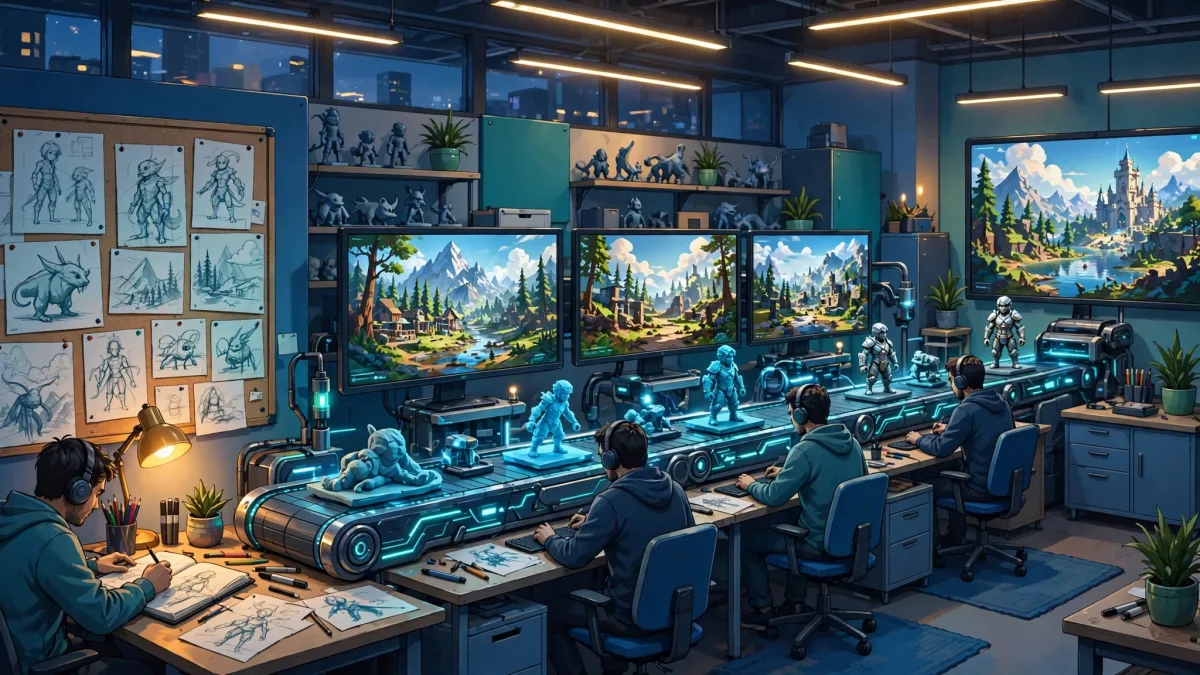
Every game project rebuilds a surprising amount of invisible infrastructure: build systems, asset pipelines, editor extensions, save systems, input handling, localization workflows, analytics hooks, and platform certification checklists. When a studio treats those as throwaway work, each new game pays the full price again. When it treats them as a platform, each new game starts halfway to the finish line. Reusable foundations show up in four concrete places:
- Engine and tooling. A stable engine version, a shared set of editor tools, and a documented asset pipeline mean artists and designers produce usable content from week one instead of waiting months for tools to mature.
- Code libraries. Proven modules for movement, camera, UI, audio, networking, and save data get reused with confidence because they have already shipped. New code is written only where the new game genuinely differs.
- Content libraries. Rigged character templates, environment kits, VFX libraries, and animation sets let a team prototype a new world in days and reserve custom art for the moments players will remember.
- Process templates. Milestone definitions, QA checklists, certification playbooks, and release runbooks from the last project become the starting point for the next one.
The test of a foundation is not whether a studio claims to have one. It is whether the studio can show you a project that shipped faster because the foundation existed. Ask for that example by name, and ask what broke in it.
For most projects, a mature engine plus a layer of studio-owned tools beats a fully custom stack, because the engine vendor maintains the platform work while the studio invests in game-specific tooling. The decision framework is similar to the broader build-versus-buy question covered in our guide on custom versus off-the-shelf software: custom wins only where it creates a real competitive edge, and everywhere else it is a tax on every future project.
AI Pipelines and Faster Game Development in Practice
Artificial intelligence is now a normal part of production pipelines. A 2026 survey by Japan's Computer Entertainment Supplier's Association (CESA), covering 1,349 respondents, found that 85.8% of Japanese game developers use generative AI in their working process, with 63% using it daily, up from 51% in 2025. Most of that use is in support roles: 39% use it for idea presentation, trials, or in-house assets, 28% use it to automate workflow or testing, and 22% use it to generate or modify assets, while humans still create the final product in most cases.
Unity's 2026 Game Development Report, as reported by MobileAppDaily, found that median project development time dropped from 91 hours to 21 hours between January 2022 and December 2025, and that 62% of surveyed studios now use AI for back-end coding assistance. Those figures describe the speed of individual project tasks and prototyping cycles rather than the full timeline of a AAA game. The direction is unmistakable: AI assistance is compressing the first pass of many production tasks, which is exactly where faster game development is won or lost.
In a well-run pipeline, AI earns its place in three stages:
1. Concept and prototyping
AI tools generate first-pass concept variations, placeholder assets, and boilerplate code, so a mechanic can be playtested in days instead of weeks. The goal is faster iteration on what is fun, not faster production of final art. Teams that prototype quickly kill bad ideas cheaply, which is one of the largest hidden time savings in any project.
2. Asset production
AI-assisted tools produce texture variations, prop placements, background art, and animation drafts that artists then select, refine, and finalize. The artist remains the author of the final asset. What changes is how many starting points the artist can evaluate in a day. AI-assisted game creation tools such as Google's Unity Playground, explained in our earlier article on AI game creation, show how quickly first drafts can now appear, but the professional pipeline still depends on human judgment at the finish line.
3. QA, localization, and live operations
QA is where pipelines quietly lose the most time. Automated testing bots can run regression passes across builds, flag likely bugs, and re-test fixed issues without waiting for a human tester to replay the same section for the twentieth time. AI-assisted QA does not replace human playtesters, who catch feel, fairness, and fun problems that no script can judge. It frees them from repetitive verification so they spend their hours on judgment work instead. AI also produces first-pass translations and patch notes that human reviewers verify before release.
The honest limit matters as much as the promise. The CESA survey found that 40% of respondents do not use generative AI in released products and services at all. Many studios use it to make the pipeline more efficient while keeping final creative decisions human. Buyers should be wary of any vendor that promises an "AI-made game" with no human craft in the loop.
Scope Discipline: The Live-Service Trap
The fastest way to make a game take eight years is to keep adding to it. Live-service ambitions are the most common version of this trap. A game designed as a one-time release that slowly grows a roadmap of seasons, events, battle passes, and social systems becomes a project with no finish line. Each added system multiplies testing, balancing, and content work.
Scope discipline is not about making small games. It is about deciding, up front, what the game must be at launch and what can wait. The strongest pipelines enforce this with three habits:
- A vertical slice first. Build one complete, playable slice of the game, with final-quality art, systems, and feel, before scaling content. If the slice is not fun, no amount of extra content will fix it.
- A locked launch scope. Features that arrive after the launch scope is locked go into a post-launch list, ranked by player value.
- Kill criteria. Every major system gets a date by which it must prove itself in playtesting or be cut or simplified. Without kill criteria, weak systems survive on sunk-cost reasoning until they are too expensive to remove.
Milestones, Rework, and the Real Pipeline Test
Rework is the silent tax on game development. The pattern is familiar: a feature is built, reviewed late, found to clash with the game's feel or with another system, and rebuilt. One round of rework is normal. Three rounds means the pipeline has a feedback problem, not a talent problem. The studios with genuinely faster pipelines move feedback earlier, where it is cheap.
Concretely, that means playable builds on a fixed cadence, ideally weekly, that the whole team and the client can play. Design reviews happen against the playable build, not documents. Art is reviewed in-engine, in the lighting and context players will see. Every milestone gets a definition of done written before work starts. Milestones should also be tied to risk: the highest-risk items, such as networked multiplayer or a novel control scheme, get built and tested first, while the project still has time to change direction. Finally, measure the pipeline, not just the product: build success rate, time from code change to playable build, asset turnaround time, bug reopen rate, and the share of milestones delivered without scope changes.
What to Ask a Game-Dev Partner Before You Sign
If you are commissioning a game, an interactive experience, or an AR/VR product, the pipeline conversation matters more than the pitch deck. A studio's portfolio shows what it shipped. Its pipeline answers whether it can ship yours on time. Judge the answers below by their specificity.
| Area | Question to ask | What a strong answer sounds like |
|---|---|---|
| Reusable foundation | What engine, tools, and code from your last project will carry into mine? | A named list of modules and tools, plus one project that shipped faster because of them. |
| AI usage | Where exactly do you use AI in production, and where do humans have final say? | Stage-by-stage disclosure, with human review on final art, code, and QA sign-off. |
| Milestones | How often will I get a playable build, and what does done mean for each milestone? | Weekly or biweekly playable builds with written acceptance criteria. |
| Scope control | How do you handle feature requests after launch scope is locked? | A post-launch backlog with ranking rules, not ad hoc additions to the current sprint. |
| Risk | What is the riskiest part of my project, and when will you build it? | The hard problem named in the first meeting, scheduled first, with a fallback plan. |
| Launch and beyond | What happens after launch: patches, live events, platform updates? | A written post-launch support plan with response times and update cadence. |
One more question belongs on every buyer's list: who owns the tools and assets if the relationship ends? Make sure your contract covers source code, art assets, tooling, and documentation handover, so your game survives any change of vendor. Studios offering game development and AR/VR services should be able to answer all of these questions in the first conversation.
Frequently Asked Questions
How long does it take to develop a game in 2026?
It depends on scope. A focused mobile or indie title can ship in months, a mid-size PC or console game typically takes one to three years, and a large open-world AAA game can take far longer. Reusable tooling, a locked launch scope, and early risk reduction shorten timelines more reliably than adding headcount.
Does AI really make game development faster?
Yes, in specific stages: prototyping, first-pass assets, boilerplate code, automated testing, and first-pass localization. CESA's 2026 survey found 85.8% of Japanese game developers use generative AI at work. The gains come when humans keep final creative and quality decisions, because AI output still needs review and integration.
What is the biggest cause of game development delays?
Scope growth and late feedback. Features added after launch scope is locked multiply testing and balancing work, while design problems caught late require expensive rework. Playable builds on a fixed cadence, a vertical slice early, and kill criteria for unproven systems are the most effective defenses.
Should my game be a live-service title?
Only if you are prepared to fund ongoing content, events, balancing, and community support after launch. For many brands and publishers, a polished one-time release with a small post-launch support plan is the faster, lower-risk path to a shipped game.
What should I look for in a game development partner?
Look for a reusable pipeline, a named team, playable builds on a fixed cadence, transparent AI usage, disciplined scope control, and a written post-launch plan. Ask for a past project that shipped faster because the studio's foundation carried over. Specific answers beat polished portfolios.
The Rockstar story is not really about Rockstar. It is about what every studio learns eventually: the second game on a good foundation is faster than the first. If you are planning a game, an interactive experience, or an AR/VR product, choose the partner whose pipeline is already built. Contact our team to discuss your game idea, your timeline, and the pipeline that will get it shipped.
Related Articles
Keep reading — more guides you may find useful.


Related Services
Services connected to this guide.