
DeepSeek Super-Agent: A Business Guide to AI Coding Agents
DeepSeek Super-Agent is a research prototype that turns approved repository requests into pull requests. This guide explains how businesses can pilot it safely, with strict permissions, human review, and honest measurement.
The Short Answer
On 31 October 2026, DeepSeek's Harness team published an open-source coding agent prototype that quickly became one of the most talked about AI releases of the week. DeepSeek Super-Agent is not a finished product, and DeepSeek is unusually clear about that: the team calls it a research prototype, not an official DeepSeek product, and warns…
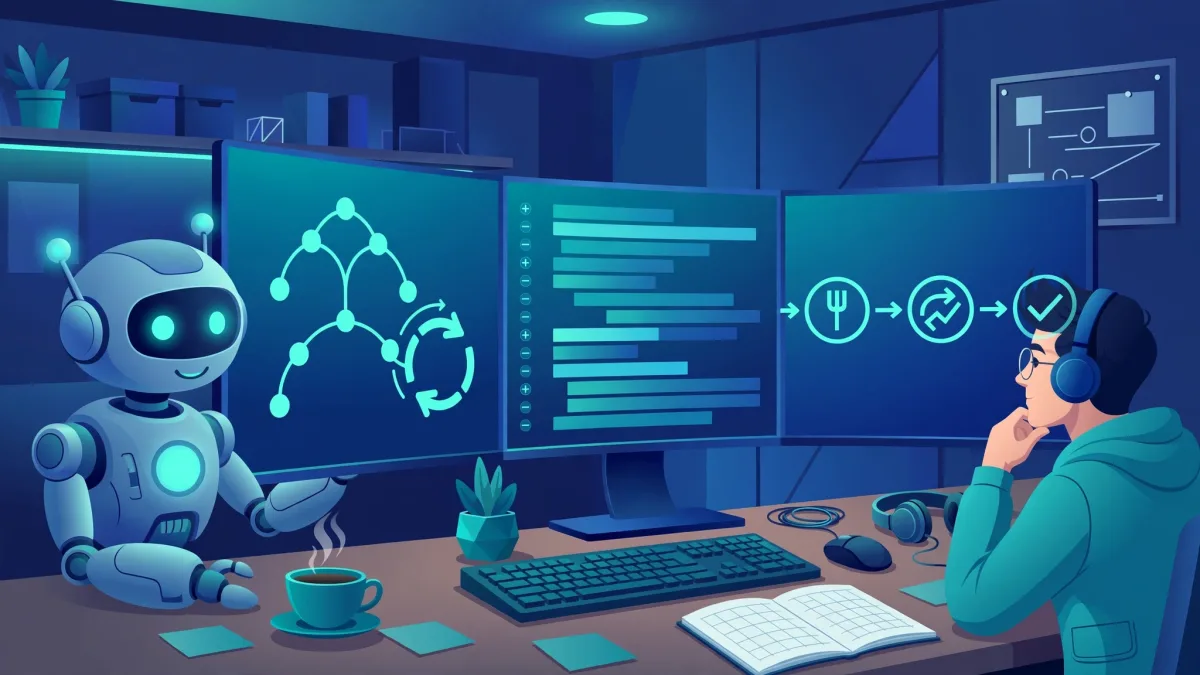
On 31 October 2026, DeepSeek's Harness team published an open-source coding agent prototype that quickly became one of the most talked about AI releases of the week. DeepSeek Super-Agent is not a finished product, and DeepSeek is unusually clear about that: the team calls it a research prototype, not an official DeepSeek product, and warns the code is not production-ready. Even so, it matters for any business that builds software, because it points to a different way of working: instead of a developer opening an AI tool and asking for help, an agent watches a repository, picks up approved requests, and returns with a pull request for a human to review.
This guide explains what DeepSeek Super-Agent does, who it is for, how to pilot it safely, and what to check before agent-written code reaches your customers. Every performance figure here is vendor-reported by DeepSeek or covered by journalists, and we flag those claims as such. No independent benchmark of the public prototype exists yet, so treat the numbers as an early signal, not proof.
What Is DeepSeek Super-Agent?
DeepSeek Super-Agent is a proactive coding agent for one GitHub repository, published as deepseek-ai/dsh-superagent-prototype under the MIT licence. It is packaged as a bundle for DeepSeek Harness, the open-source agent runtime released separately in August 2026. It listens to GitHub events and can also take requests from Feishu, the chat app sold as Lark outside China.
The project's stated idea is to take as little human attention as possible, and give as much value as possible. The agent stays available in the background, takes requests from allowed people, and speaks up only when a person must act or can use a result. When an approved member asks for work, it opens a work item, handles it in its own session and directory, and replies in the original conversation, for example with a pull request: a formal proposal for the team to review and merge. Nothing goes live without a human decision.
Separate the public prototype from the fuller vision. DeepSeek says it differs from its internal version, much of the engineering was done by coding agents, and the code may still contain bugs. Some designs in the essay Exploring Super-agent Design are future directions, not implemented here. It is an experiment to study and test, not a supported tool for production on day one.
How DeepSeek Super-Agent Works
The design has two layers: a persistent Router handling incoming requests, and separate Worker sessions carrying out individual jobs in parallel. Each work item gets its own session and directory, so the agent can take a new request before the last one finishes, and a Worker owning a pull request can follow its comments. A local web panel lists only items needing a human decision.
Authorisation comes before initiative. The agent acts only when asked by an allowed person, or when a written rule created by the team permits the work. For unasked work, the documented default is record-only mode: the agent notes what it would have done, without accepting the task. That rule is the most business-friendly idea in the release, because it turns proactivity from a risk into something a team can review, tune, and only then switch on.
DeepSeek reports its internal version already reproduces and fixes reported bugs and responds to code reviews. Those vendor-reported claims concern the internal system, not the public prototype, and that gap is exactly why a careful pilot matters.
Who Should Pilot DeepSeek Super-Agent, and Who Should Wait
This prototype fits teams that already work in GitHub, review every change through pull requests, and have a non-critical repository where an experiment cannot hurt customers. Software agencies, product teams with a side project or internal tool, and engineering teams evaluating agent workflows are natural candidates. Structured code review, automated tests, and staged deployments already give you most of the safety net a pilot needs.
Wait, or proceed only with expert help, if your only repository is a live production system with no staging environment, if your code handles payments or regulated records and you cannot yet audit an agent's changes, or if nobody on your team can read and challenge a pull request properly. An agent is only as safe as the review that follows it. For such teams, strengthen review and testing first, and explore managed AI and machine learning services with a delivery partner.
Small businesses without an in-house development team should also wait. Setup needs a dedicated GitHub account, Node.js 22.19 or later, GitHub CLI 2.48 or later, and a model provider configured in DeepSeek Harness, and reports note only github.com is supported, not GitHub Enterprise Server. If that list means nothing to your team, a partner-led pilot is better.
A Safe 2-Week Pilot Plan for Businesses
A pilot should prove value on boring, low-risk work before it touches anything customers depend on. This plan suits a team of roughly five to fifteen developers, and keeps a human in charge at every step.
Week 1: Set up, restrict, and observe
- Pick one sacrificial repository. Choose an internal tool or documentation site with no customer data and no production traffic. Never pilot on your main product repository.
- Create a dedicated agent account. Give the agent its own GitHub account with access to that one repository only, never a developer's personal or admin account.
- Give it the smallest possible permissions. The agent should read code and open pull requests, and nothing else: no pushes to the main branch, no secrets, no deployment rights, no other repositories.
- Keep proactivity in record-only mode. Let the agent log what it would have done on unasked work, and review that log as a team. Switch on rule-based work only after the log shows consistently sensible suggestions.
- Define the allowed requesters. Write down exactly who may ask the agent for work, and in which channels. Everyone else's requests should be ignored by design, not by luck.
Week 2: Run real tasks, review everything, and score it
- Feed it ten small tasks. Examples: fixing a low-severity bug, adding a missing test, updating documentation, or refactoring one small function. Avoid new features, security code, and database migrations in week 2.
- Review every pull request like a junior developer wrote it. Check the logic, run the tests, and ask whether it does anything beyond what was asked. Approve only what you fully understand.
- Score each pull request. Record whether it merged unchanged, merged after edits, or was rejected, plus review time. If review takes longer than doing the task by hand, the agent is not saving time.
- Decide on evidence, not enthusiasm. Expand only if most pull requests were useful, review time fell, and none introduced a defect or unwanted change. Otherwise, pause and revisit the setup.
A worked example: what a good pilot week looks like
Imagine a twelve person team with a staff-only internal dashboard. In week 2 it gives the agent ten tasks: three bug fixes, four missing tests, two documentation updates, and one refactor. The agent returns nine pull requests and stalls on one, closed by hand. Four merge unchanged, three merge after small edits, and two are rejected for changing behaviour nobody asked for. Review takes about fifteen minutes per pull request, against roughly forty minutes per task by hand. The team saves time on seven tasks and rewrites its request template to state what must not change. That is a successful pilot, not because the agent was perfect, but because the team measured it and fixed the process.
What to Check Before You Trust Agent-Written Code
Agent-written code deserves the same checks as any other code, plus extras targeting how agents typically fail. Agents are fluent and confident, which makes their mistakes easy to miss. Apply this checklist to every agent pull request.
| Check | What to look for | Why it matters |
|---|---|---|
| Scope | Does the change do only what was asked? | An unasked change is unreviewed. |
| Tests | Do existing tests pass, and is there a new test proving the fix? | A fix without a test can break again. |
| Secrets and data | Any hard-coded keys, credentials, or customer data? | Leaked credentials are hard to undo. |
| Dependencies | Did the agent add a new library, and is it trusted and needed? | Each dependency adds supply chain risk. |
| Security | Are inputs validated and permissions checked on new paths? | Generated code can look secure yet miss a check. |
| Readability | Could another developer maintain this code in six months? | Unreadable code cannot be safely owned. |
Two structural rules matter more than any single check. Never let an agent merge its own pull request or push to your main branch, and run every agent change through the same tests and deployment pipeline as human code, with no shortcut. If your testing is thin, fix that first: a disciplined pre-launch testing checklist and a proper software testing and quality assurance process make agent assistance safe rather than merely fast.
The Limits You Must Take Seriously
DeepSeek lists open problems that should shape any business decision: Router scaling, long-term memory, communication between agents, and prompt injection risk when a cloud agent can access credentials on local devices. Prompt injection is the standout risk: hostile text hidden in an issue, comment, or document could steer the agent into doing something its owners never intended. Run the prototype with minimal privileges, and review its plugins and generated commands, as DeepSeek's own Harness warnings advise.
The performance evidence is also narrow. In DeepSeek's preliminary synthetic tests, the team reported completing half of roughly 20 requests within 12.4 minutes, and the slowest 5 percent took 15.7 minutes against 29.5 minutes for a conventional single-session setup. Those vendor-reported results come from simulated workloads, not independent benchmarks or real-world code quality, and the agent approach used more cached tokens. Ask not just how fast an agent finishes, but how much review time it creates and how often its work survives review unchanged.
Finally, remember the licence reality. The MIT licence permits use, copying, modification, and distribution, but without warranty. No vendor support line exists for a research prototype, and future versions may change behaviour without notice. Acceptable for an experiment, unacceptable as the foundation of a client delivery commitment.
DeepSeek Super-Agent and Traditional Coding Assistants
Most coding assistants wait for a developer to open a session and ask. DeepSeek Super-Agent inverts that pattern: it stays resident, watches a repository, and answers where the work began.
| Feature | Traditional coding assistant | DeepSeek Super-Agent prototype |
|---|---|---|
| How work starts | A developer opens a session and asks | An approved request, or a team-written rule |
| Scope | One developer's session | One GitHub repository, team-wide |
| Output | Suggested code in the editor | A pull request for human review |
| Maturity | Established products with support | Research prototype, not production-ready |
The strategic question is not which tool writes more code, but which workflow wastes less human attention. A resident agent returning clean, reviewable pull requests could beat a chat assistant that interrupts a developer at every step, but that depends on review quality, permission design, and honest measurement, which are the buyer's job. Production teams often pair such experiments with professional custom software development and a mature cloud and DevOps pipeline, so agent output passes the same gates as other changes.
Frequently Asked Questions
Is DeepSeek Super-Agent an official DeepSeek product?
No. DeepSeek calls it a research prototype for reference only, not an official DeepSeek product, and warns it is not production-ready. Evaluate it as an experiment, not a supported product.
Can DeepSeek Super-Agent work on its own without being asked?
Only within rules the team writes. It acts when asked by an allowed person or when a written rule permits the work, and unasked work starts in record-only mode, logging what it would have done. Keep that setting until its suggestions prove consistently sensible.
Which repositories can it work with?
It is built for one GitHub repository at a time, listening to GitHub events and optionally to Feishu. Reports note only github.com is supported, not GitHub Enterprise Server, so enterprise-hosted organisations should check compatibility before planning a pilot.
What is the biggest risk of piloting it?
Weak review, not weak code. An agent can produce plausible code that overreaches, misses a security check, or follows a hidden instruction in an issue comment. Minimal permissions, mandatory pull request review, automated tests, and a ban on self-merging keep that risk manageable.
Should our business pilot DeepSeek Super-Agent now?
Pilot now only if you have a disposable repository, a team that reviews pull requests rigorously, and two weeks to measure results honestly. Otherwise, watch the project, strengthen your testing and deployment pipeline first, and revisit it when the prototype matures or a partner can run the pilot.
The bottom line: DeepSeek Super-Agent shows where coding agents are heading, from tools that wait to be asked toward agents that watch, propose, and step aside for human judgment. Treat it as a research prototype, pilot it on low-risk work with strict permissions and review, and judge it by merged pull requests and review time, not headlines. For help designing a safe pilot, or building the testing and deployment pipeline it depends on, contact Skills Technology Solutions and tell us about your repository and your team.
Related Articles
Keep reading — more guides you may find useful.

Related Services
Services connected to this guide.