
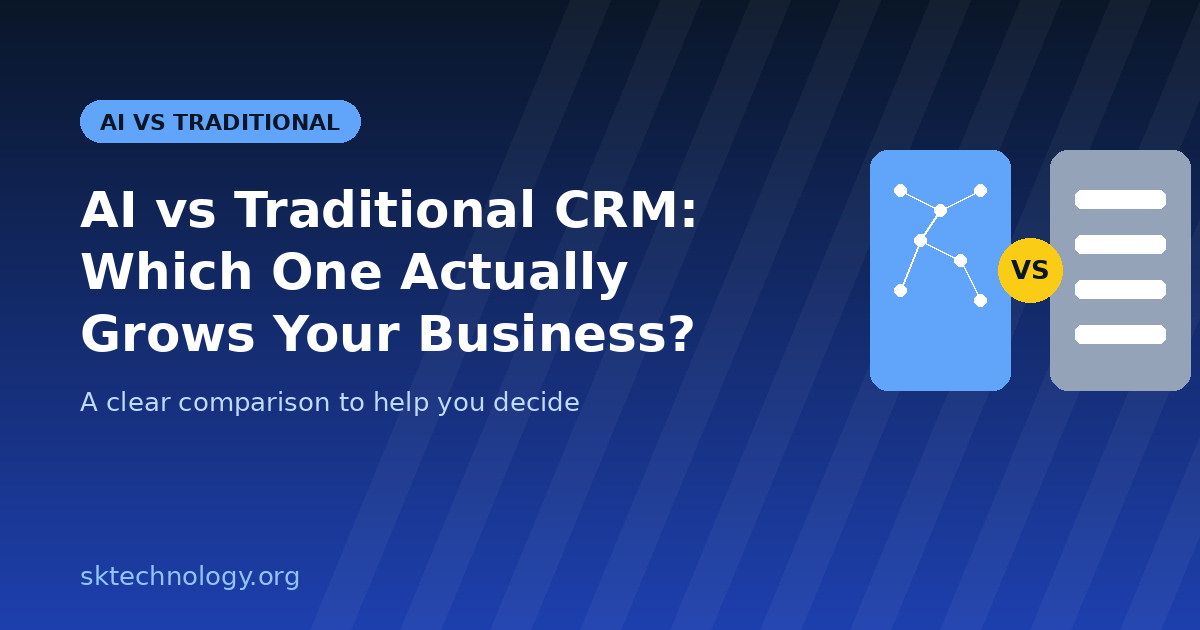
AI vs Traditional CRM: Which One Actually Grows Your Business?
Comparing AI-powered CRMs with traditional CRM systems to help businesses decide which approach truly drives growth, efficiency, and stronger customer relationships.
The Short Answer
A traditional Customer Relationship Management (CRM) system is primarily a database for storing customer information, tracking interactions, and managing sales pipelines. It requires manual data entry and relies heavily on the sales or support team to interpret information and take action.
What Is a Traditional CRM?
A traditional Customer Relationship Management (CRM) system is primarily a database for storing customer information, tracking interactions, and managing sales pipelines. It requires manual data entry and relies heavily on the sales or support team to interpret information and take action.
What Is an AI-Powered CRM?
An AI-powered CRM goes beyond simple data storage. It uses artificial intelligence to analyze customer behavior, predict sales trends, automate follow-ups, and provide actionable insights — reducing manual work while improving decision-making.
Key Differences Between AI and Traditional CRMs
1. Data Entry and Management
Traditional CRMs require manual data entry for most updates. AI-powered CRMs can automatically log interactions, update records, and pull data from emails, calls, and forms without manual input.
2. Lead Scoring and Prioritization
Traditional systems often rely on manual lead scoring based on simple rules. AI CRMs analyze behavior patterns and engagement history to automatically prioritize the leads most likely to convert.
3. Predictive Insights
Traditional CRMs show historical data. AI CRMs go further by predicting customer churn, forecasting sales trends, and recommending next best actions based on patterns in the data.
4. Automation of Follow-Ups
With a traditional CRM, sales reps must remember to follow up manually. AI CRMs can automatically trigger personalized follow-up emails or reminders based on customer behavior.
5. Time and Resource Efficiency
Traditional CRMs require more staff time to manage and analyze data. AI CRMs reduce this workload significantly, freeing up teams to focus on building relationships instead of data management.
Which One Actually Grows Your Business?
For small businesses with simple sales processes, a traditional CRM may still be sufficient. However, as a business scales, the manual limitations of traditional CRMs can slow growth. AI-powered CRMs help businesses grow faster by automating repetitive tasks, improving lead quality, and providing data-driven insights that lead to smarter decisions.
Conclusion
While traditional CRMs laid the foundation for customer relationship management, AI-powered CRMs are proving to be the stronger growth engine for modern businesses. By automating processes and delivering predictive insights, AI CRMs help businesses convert more leads, retain more customers, and scale more efficiently.
Related Articles
Keep reading — more guides you may find useful.
Related Services
Services connected to this guide.